Car and Boat Accidents at Silverwood Lake: Legal Guide
Silverwood Lake accident guide: Highway 138 boat trailer crashes, jet ski collisions, government tort claims, multi-agency jurisdiction, and how to protect your claim.
- By
- Victorville PI Resource Editorial Team
- Published
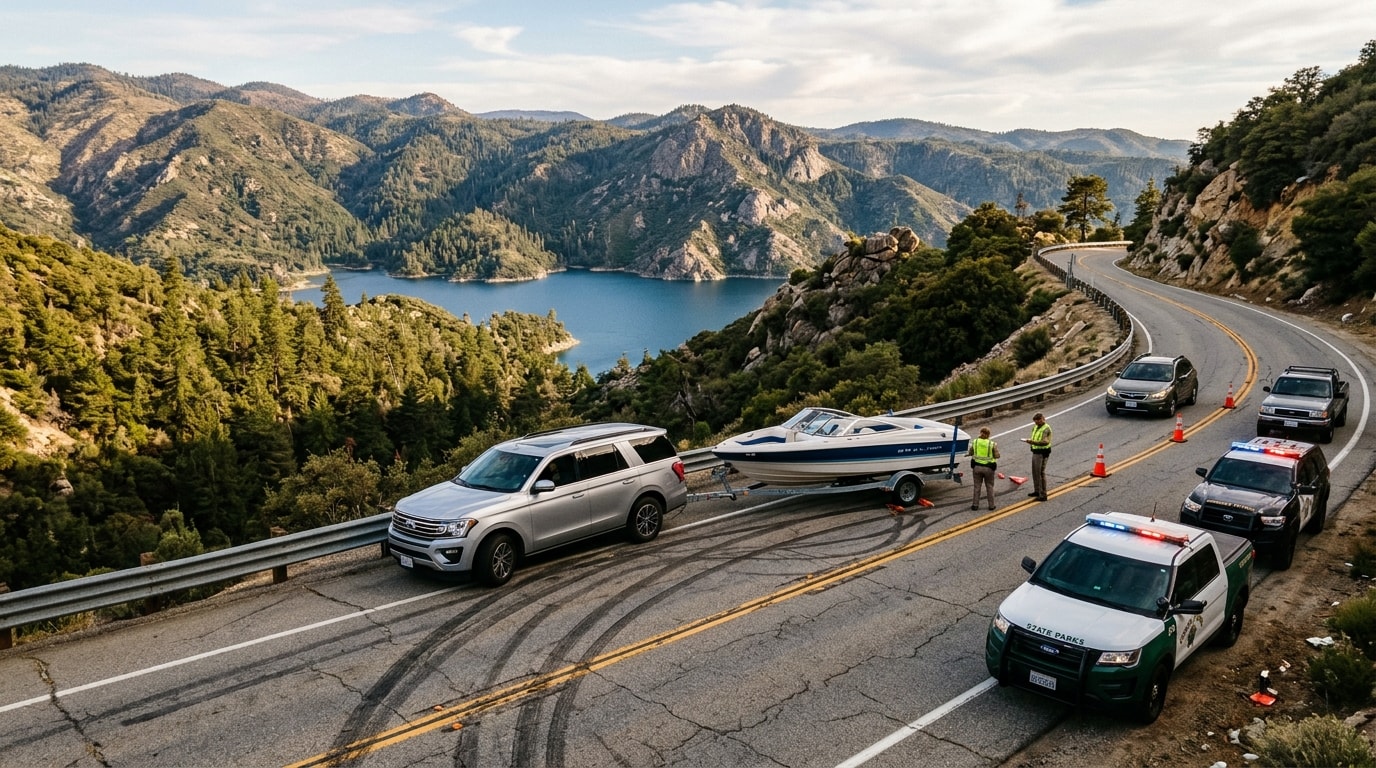
Silverwood Lake State Recreation Area draws hundreds of thousands of visitors annually from the High Desert and the Inland Empire. Getting there requires navigating some of the most treacherous mountain roads in Southern California — and once on the water, the lake's confined geography and crowded summer conditions create a second layer of catastrophic injury risk. If you were injured on the approach highways or on the lake itself, your case involves legal complexity that goes far beyond a standard car accident claim.
Two types of Silverwood Lake accidents — and why both are uniquely complex
Injuries at Silverwood Lake fall into two fundamentally different categories, each governed by different legal frameworks.
Mountain highway approach crashes occur on Highway 138, Cleghorn Road, and Pilot Rock Road — steep, winding alpine roads with sharp switchbacks, 6 to 8 percent grades, and minimal guardrails. Vehicles towing boat trailers are particularly vulnerable on these roads because the added weight and length amplify every hazard: brake fade on descents, trailer sway on curves, and jackknife dynamics during emergency braking.
Watercraft collisions on Silverwood Lake involve boats, personal watercraft (jet skis and PWCs), and launch ramp incidents. These accidents are governed by the California Harbors and Navigation Code and California State Parks Division of Boating and Waterways regulations — not the Vehicle Code that applies to highway crashes. The liability analysis, the investigating agencies, and the insurance frameworks are all different.
What both categories share is jurisdictional complexity. Multiple law enforcement agencies operate in and around Silverwood Lake, and identifying which agency investigated your incident determines where you obtain the official report.
Mountain highway approach crashes: boat trailers, brake fade, and steep grades
The roads leading to Silverwood Lake are engineered for light passenger traffic — not 7,000-pound trucks towing 5,000-pound boat trailers down 6 to 8 percent mountain grades. Brake fade is the single most common mechanical failure on these descents. When a driver rides the brakes continuously down a long grade, the brake fluid boils, the pads overheat, and braking force drops to near zero. A vehicle and trailer combination that has lost braking on a hairpin switchback becomes an uncontrollable projectile.
Trailer jackknife occurs when the tow vehicle decelerates faster than the trailer, causing the trailer to swing sideways and push the vehicle off its line. On narrow mountain roads with no shoulder and steep drop-offs, a jackknifed boat trailer can sweep across the center line into oncoming traffic or push the entire rig over the edge.
Rollover crashes on hairpin curves account for a significant portion of Silverwood approach injuries. The high center of gravity created by a boat on a trailer — combined with excessive speed on curves — produces single-vehicle rollovers that eject occupants and crush vehicle cabins. CHP officers from the Arrowhead Area or San Bernardino Area offices investigate these highway collisions and generate the Traffic Collision Report.
Watercraft accidents: collisions, jet ski injuries, and launch ramp crashes
Accidents on Silverwood Lake are governed by a completely separate legal framework. The California Harbors and Navigation Code establishes rules of navigation, speed zones, and operator responsibilities on state waterways. California pure comparative negligence applies to watercraft collisions just as it applies to highway crashes — each operator's percentage of fault reduces their recovery proportionally.
Personal watercraft (jet ski / PWC) collisions produce disproportionately severe injuries because these craft operate at high speed with no protective structure around the rider. Traumatic brain injuries, spinal cord compression fractures, and high-speed water-impact lacerations are common. Jet ski operators who collide with swimmers, kayakers, or anchored boats near coves face both civil liability and potential criminal charges under the Harbors and Navigation Code.
Launch ramp crashes represent a distinct hazard category. Defective or poorly maintained public launch ramps — cracked concrete, algae-slick surfaces, missing dock cleats, inadequate depth markers — can cause vehicles to slide uncontrolled into the water, trailers to detach and strike bystanders, or boats to capsize during launch. When a defective public facility contributes to the injury, government entity liability enters the analysis.
The 6-month government tort claim deadline you cannot miss
When a defective public facility contributed to your Silverwood Lake injury — a dangerous launch ramp surface, missing or misleading navigational buoys, inadequate signage on approach roads, or negligent supervision by State Park personnel — your claim is against a government entity. This triggers the California Government Tort Claims Act, which imposes procedural requirements that are far more restrictive than standard personal injury claims.
Under California Government Code § 911.2 (opens in new tab), you must file a written notice of claim with the responsible government entity within six months of the date of injury. This is not a lawsuit — it is a mandatory administrative prerequisite. The notice must identify the specific dangerous condition, the date and location of the incident, the injuries sustained, and the amount of damages claimed.
Missing this six-month deadline can permanently bar your claim against the government entity, even if the dangerous condition was the direct cause of your catastrophic injury. This deadline is half the standard two-year statute of limitations for personal injury — and many Silverwood Lake crash victims do not learn about it until it has already passed. If a public facility defect contributed to your accident, filing the government tort claim notice is the single most time-sensitive action in your case.
Navigating multi-agency jurisdiction and building your claim
Silverwood Lake incidents can involve up to four separate law enforcement and regulatory agencies, and each generates different reports through different systems.
California State Park Peace Officers (Rangers) have primary jurisdiction within the Silverwood Lake State Recreation Area boundaries. They investigate on-water incidents, launch ramp accidents, and incidents on park roads. San Bernardino County Sheriff Marine Enforcement assists with watercraft accident investigation and water rescue operations. CHP Arrowhead Area or San Bernardino Area offices investigate highway collisions on the approach roads (Highway 138, Cleghorn Road). San Bernardino County Fire and CalFire provide emergency medical response.
Identify which agency responded to your incident and request the official report immediately. For on-water incidents, the State Parks report may be the only official documentation — and obtaining it requires contacting the Silverwood Lake State Recreation Area office directly.
A Victorville personal injury lawyer experienced in multi-jurisdiction claims can navigate the overlapping agency structures and ensure no report is missed. The mountain highway hazards at Silverwood share characteristics with crashes on Highway 138 and the mountain motorcycle corridor, and the geographic complexity mirrors the jurisdictional challenges faced by crash victims in Hesperia and the Cajon Pass.
This resource is independent and free to use. It is not a law firm and does not provide legal advice. For advice about your specific situation, speak with a qualified attorney.