Motorcycle Accidents in the San Bernardino Mountains
How motorcycle accidents on Highway 138, the Cajon Pass, and Wrightwood mountain roads are caused by cars crossing the centerline — and how adjusters unfairly blame riders for mountain crashes.
- By
- Victorville PI Resource Editorial Team
- Published
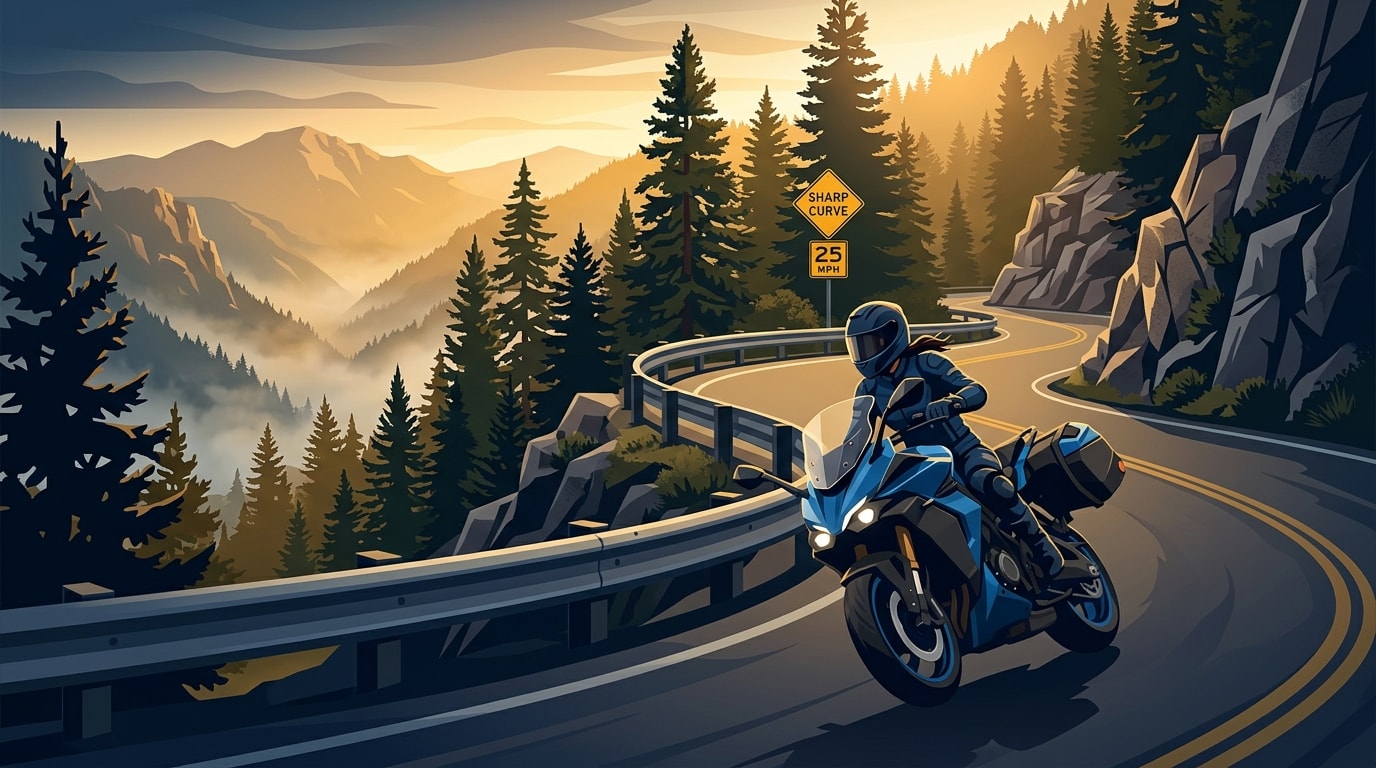
The San Bernardino Mountains offer some of the most exhilarating riding in Southern California — and some of the most dangerous. Highway 138, the Cajon Pass switchbacks, the routes climbing toward Wrightwood, and the Pearblossom corridor draw riders from across the region with their combination of elevation changes, sweeping curves, and mountain scenery. But these same roads produce devastating motorcycle crashes when cars cross the centerline on blind curves, when debris covers the roadway after storms, and when the distance between the crash scene and the nearest trauma center is measured in helicopter flight time rather than ambulance minutes. This guide is general legal information, not legal advice.
The riding routes that make the San Bernardino Mountains both thrilling and deadly
Highway 138 is the primary east-west corridor connecting the I-15 at Cajon Junction to the I-5 near Gorman. The route passes through the San Bernardino National Forest, climbing through sharp switchbacks, blind curves, and elevation changes that create the technical riding conditions that attract experienced motorcyclists. It is also one of the most documented crash corridors in the region.
The Cajon Pass descends from the mountains into the High Desert, with steep grades, heavy commercial truck traffic, and transition zones where mountain road conditions change rapidly to high-speed freeway conditions. Riders descending the pass must navigate grade-related speed management while sharing lanes with 80,000-pound trucks — a combination that produces severe consequences when any vehicle misjudges speed or following distance.
The routes to Wrightwood — including Big Pines Highway and Angeles Crest Highway connections — offer tight, technical curves through forested mountain terrain. These roads attract recreational riders on weekends and are popular for group rides. The narrow lanes, limited sight distance on curves, and occasional sand or gravel on the road surface create conditions where a single unexpected hazard can cause a catastrophic single-vehicle crash or a multi-vehicle collision.
How cars crossing the centerline cause mountain motorcycle crashes
The most dangerous crash scenario on mountain roads is a head-on collision caused by a car cutting the corner on a blind curve and crossing into the oncoming lane — directly into the path of an approaching motorcycle.
On mountain roads, many drivers instinctively cut curves to maintain speed, drifting across the double-yellow centerline at the apex of the turn. In a car-to-car collision, this behavior produces serious injuries. In a car-to-motorcycle collision, the rider has no vehicle frame protection, no crumple zone, and no airbags — the impact is absorbed entirely by the rider's body.
The physics are unforgiving. A motorcycle traveling at 40 mph on a mountain curve that encounters a car crossing the centerline at 35 mph experiences a combined impact speed of 75 mph. At that speed, the rider is thrown from the bike with forces that produce traumatic brain injuries (even with a helmet), spinal fractures, multiple long-bone fractures, and severe road rash from sliding across asphalt at highway speed. The rider frequently leaves the roadway entirely, landing on rocky terrain or hillside that compounds the initial impact injuries.
How adjusters blame riders for "taking curves too fast" — and why it fails
Insurance adjusters handling mountain motorcycle crashes rely on a predictable playbook: blame the rider for the road. The adjuster's argument is that the rider was "taking curves too fast," "riding beyond their skill level," or "using a recreational road recklessly." This argument exploits a cultural bias that treats motorcycling as inherently reckless — a bias that has no basis in California law.
The reality is that in a large percentage of mountain motorcycle crashes, the other driver caused the collision by crossing the centerline, failing to yield at an intersection, or making an unsafe U-turn on a blind curve. The rider was traveling legally, within the speed limit, in their own lane — and the car entered their space.
Defeating the adjuster's bias requires evidence. Helmet camera footage is the single most powerful tool available to mountain riders — it captures the other vehicle's position relative to the centerline at the moment of impact. CHP collision reconstruction reports document skid marks, debris fields, and vehicle rest positions that establish where the impact occurred relative to the lane markings. Witness statements from other riders or motorists who saw the car cross the centerline complete the liability picture. For a broader look at how insurance adjusters use lowball tactics to reduce motorcycle claims, our guide exposes the full playbook.
Delayed emergency response: why mountain crash injuries are more severe
Mountain motorcycle crashes produce more severe outcomes than equivalent-speed crashes in urban settings, and emergency response time is a primary reason. On Highway 138 or the remote stretches near Wrightwood, a crash victim may wait 20 to 45 minutes for CHP and ambulance arrival — compared to 5 to 10 minutes in Victorville or Hesperia.
The CHP San Bernardino office (opens in new tab) covers a vast geographic area that includes remote mountain terrain with limited road access. Ambulances dispatched from the nearest fire station may need to navigate the same winding roads that caused the crash, adding critical minutes to the response. For the most severe injuries — spinal cord damage, uncontrolled hemorrhage, severe TBI — the response time difference between mountain and urban settings can mean the difference between a recoverable injury and a permanent disability.
Air ambulance transport is frequently required for serious mountain crashes. Helicopter transport from a mountain crash scene to a Level I trauma center (Arrowhead Regional or Loma Linda) adds $25,000 to $75,000 or more to the medical bills — but it can save the victim's life or preserve neurological function that would be lost during a longer ground transport. These air ambulance costs are recoverable as special damages in the claim.
How mountain motorcycle accident claims connect to California law
A mountain motorcycle crash is governed by the same California legal framework that applies to any personal injury case. The value is determined by the Special Damages plus General Damages formula, with the multiplier reflecting the severity and permanence of the injuries.
Mountain motorcycle injuries consistently justify the highest multipliers. Road rash requiring skin grafting produces permanent scarring that drives the multiplier to 4–5x. Traumatic brain injury documented through neuropsychological testing can push it higher. Spinal cord injuries with permanent paralysis or loss of function create cases valued in the millions.
For a detailed breakdown of how much a motorcycle accident claim is worth in California, our settlement guide explains the multiplier method, the adjuster bias dynamic, and the injury types that drive the highest values. For comprehensive coverage of how California motorcycle accident claims are evaluated and pursued, our statewide Pillar guide covers every phase from the crash through resolution.
This resource is independent and free to use. It is not a law firm and does not provide legal advice. For advice about your specific situation, speak with a qualified attorney.