California Car Accident Claims Guide
A comprehensive guide to California car accident claims: fault determination, pure comparative negligence, insurance negotiations, the two-year statute of limitations, and when local road conditions matter.
- By
- Victorville PI Resource Editorial Team
- Published

Being involved in a car accident is disorienting, and the process that follows — dealing with insurance companies, understanding fault, meeting legal deadlines — can feel overwhelming. California has specific rules that govern every stage of a car accident claim, from how fault is assigned to how long you have to take legal action. Understanding these rules before you need them gives you a significant advantage. This guide walks through the entire process from the first moments after a crash to the decision of whether to settle or go to court. It is general legal information, not legal advice.
What to do in the first days after a crash
The actions you take in the hours and days immediately following a collision shape both your medical recovery and the strength of any potential claim. Some steps seem obvious, but the specifics matter.
At the scene, if you are able, call 911 and remain where you are. Exchange insurance and contact information with the other driver, but avoid discussing who was at fault — anything you say can be used later by an insurance adjuster. Photograph the vehicles from multiple angles, capture the road conditions, traffic signals, skid marks, and any visible injuries. If there are witnesses, get their names and phone numbers.
In the first 24 to 48 hours, seek medical evaluation even if you feel fine. Some injuries — particularly soft-tissue damage, concussions, and internal bleeding — may not produce noticeable symptoms immediately. A medical record created promptly after the crash establishes a direct connection between the collision and your injuries. Gaps in treatment give insurance companies an opening to argue that your injuries were pre-existing or unrelated.
Notify your own insurance company that the accident occurred, but keep the notification factual and brief. You are generally required to report the accident under the terms of your policy, but you are not required to give a detailed recorded statement at this stage — especially not to the other driver's insurer.
How fault is determined
California is an at-fault state, which means the driver who caused the accident is financially responsible for the damages. But determining fault is rarely as simple as it sounds. It involves multiple layers of evidence, each of which contributes to the overall picture.
The police report is typically the first piece of formal evidence. The responding officer documents the scene, records statements from both drivers and any witnesses, notes traffic violations, and may include a preliminary determination of fault. While the police report is influential, it is not the final word — insurance adjusters and courts can reach different conclusions based on additional evidence.
Physical evidence from the scene often tells its own story. The location and severity of vehicle damage, the length and direction of skid marks, the final resting positions of the vehicles, and the condition of the road surface all help reconstruct what happened. In complex or high-speed crashes, an accident reconstruction expert may be retained to analyze these physical clues.
Witness testimony can corroborate or contradict the drivers' accounts. Independent witnesses — people with no connection to either party — carry particular weight. Dashboard camera and traffic camera footage, when available, can be decisive.
Electronic evidence is increasingly important. Many modern vehicles record data through event data recorders (EDRs) that capture speed, braking patterns, steering inputs, and seatbelt status in the seconds before and during a collision. Cell phone records can establish whether a driver was texting or on a call at the time of the crash.
California's pure comparative negligence system
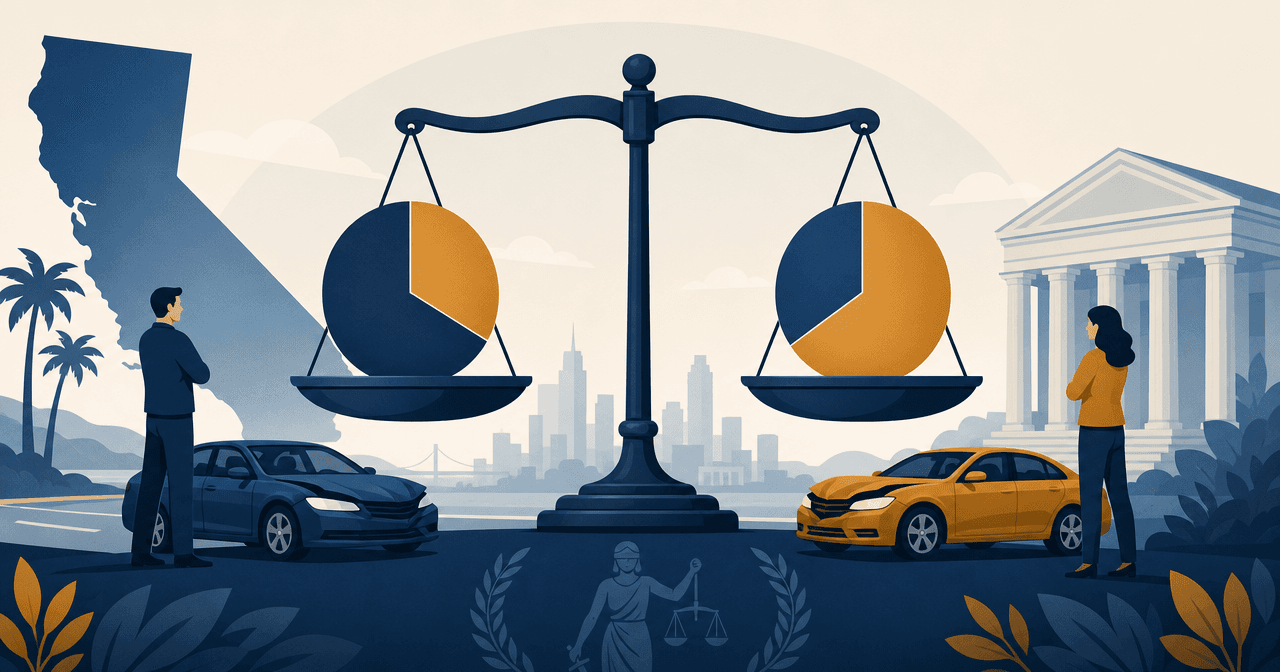
One of the most important — and most misunderstood — aspects of California car accident law is how the state handles shared fault. California follows a pure comparative negligence rule, which means you can recover damages even if you were partially at fault for the accident.
Here is how it works in practice: if your total damages are $100,000 and you are found to be 30 percent at fault, your recovery is reduced by 30 percent — leaving you with $70,000. Under California's pure system, even a driver found 90 percent at fault could still recover 10 percent of their damages. This is more favorable than the modified systems used in many other states, which bar recovery entirely once a claimant's fault reaches 50 or 51 percent.
The practical consequence is that every percentage point of fault matters. Insurance adjusters understand this well, and their strategy often focuses on inflating your share of the blame. They may use leading questions during recorded statements, scrutinize your driving history, or argue that you were speeding, distracted, or failed to take evasive action — even when the other driver was clearly the primary cause of the crash.
For a deeper explanation of how this system affects your recovery in different scenarios, including the distinction between California's pure system and the modified systems used elsewhere, see our detailed guide to California comparative negligence.
The insurance claims process
Most car accident claims in California are resolved through insurance negotiations, not courtroom litigation. Understanding how the process works helps you recognize the tactics insurers use and avoid common mistakes.
Filing a claim. You may file a claim with the at-fault driver's insurance company (a third-party claim) or with your own insurer (a first-party claim under collision or uninsured/underinsured motorist coverage). In either case, the insurer will assign an adjuster to investigate the claim, evaluate the damages, and negotiate a settlement.
The demand letter. Once you have reached a point of maximum medical improvement — meaning your condition has stabilized enough that your total medical costs and future treatment needs can be reasonably estimated — your claim is typically formalized in a demand letter. This document outlines the facts of the accident, the evidence of fault, the injuries sustained, the medical treatment received, and the total damages being claimed.
Adjuster tactics. Insurance adjusters work for the insurance company, not for you. Common tactics include requesting an immediate recorded statement (before you have had time to consult an attorney or fully understand your injuries), offering a quick, low settlement that does not account for future medical costs, and disputing the severity or cause of your injuries. Being aware of these practices helps you avoid settling for less than your claim is worth.
Bad faith. California law requires insurance companies to handle claims in good faith. If an insurer unreasonably delays processing a claim, denies a valid claim without adequate investigation, or offers a settlement that is obviously inadequate given the evidence, the insurer may be acting in bad faith — which can expose them to additional liability.
The two-year statute of limitations
California imposes strict deadlines for taking legal action after a car accident. Under California Code of Civil Procedure section 335.1 (opens in new tab), you have two years from the date of the accident to file a personal injury lawsuit. If you miss this deadline, your claim is almost certainly barred — regardless of how strong the evidence is or how severe your injuries were.
Two critical nuances apply. First, this deadline governs lawsuits, not insurance claims. You can negotiate with an insurance company at any time, but if negotiations break down, you must file a lawsuit before the two-year window closes. Second, if the at-fault party is a government entity — a city vehicle, a county bus, a state highway maintenance truck — a separate and much shorter deadline applies. You must file a formal administrative claim with the government agency within six months of the accident, and failure to meet this deadline can forfeit your right to sue.
For a complete breakdown of these deadlines, including the discovery rule and exceptions for minors, see our guide to personal injury filing deadlines.
When local road conditions contribute to a crash
Not every car accident is caused solely by driver error. In some cases, the design or maintenance of the road itself is a contributing factor — and when it is, the government entity responsible for that road may share liability.
In the Victorville area, specific intersections have documented patterns of collisions related to traffic signal timing, intersection geometry, sight-line obstructions, and the mixing of high-speed traffic with commercial turning movements. When a crash occurs at a location with a known history of similar collisions, the condition of the road itself becomes a relevant factor in determining fault.
Road condition claims add complexity because they involve government entities, which triggers the shorter filing deadlines discussed above. They also require evidence beyond what a typical driver-vs-driver claim involves — crash history data for the intersection, road maintenance records, traffic engineering standards, and expert analysis. But when the evidence supports a road condition claim, it can significantly expand the scope of a case and the sources of available compensation.
Understanding how car accident claims are handled in California — from initial investigation through settlement or litigation — is especially important in cases where multiple parties, including a government entity, may share responsibility.
This resource is independent and free to use. It is not a law firm and does not provide legal advice. For advice about your specific situation, speak with a qualified attorney.