Rotator Cuff Tear Car Accident Settlement in California
California rotator cuff tear settlement guide: steering wheel bracing mechanism, defeating the degenerative wear defense with CACI 3927, arthroscopic repair surgery, and lost earning capacity for manual workers.
- By
- Victorville PI Resource Editorial Team
- Published
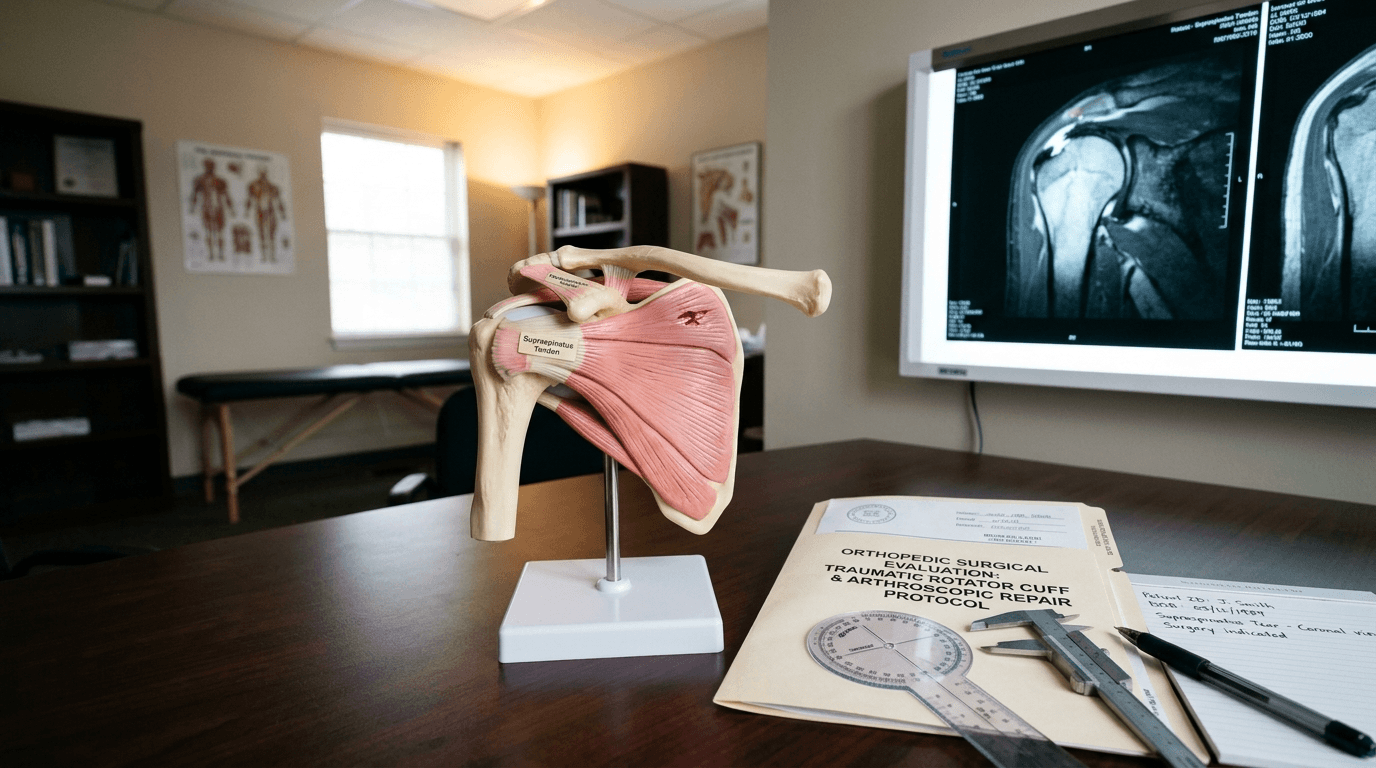
You braced against the steering wheel as the impact happened — an instinctive response that your body produced in milliseconds. Three days later, you cannot lift your arm above shoulder height. The shoulder pain wakes you at night. An MRI confirmed a full-thickness supraspinatus tear, and now the insurance adjuster is on the phone telling you that your rotator cuff was "already worn out" from years of use and the crash had nothing to do with it. That argument has a specific legal name in California, and California law has a specific, powerful answer to it.
The biomechanics of steering wheel bracing — how crashes tear the rotator cuff
The rotator cuff is a group of four muscles and their tendons that surround the glenohumeral joint — the ball-and-socket joint of the shoulder. These tendons stabilize the humeral head in the glenoid socket and power arm elevation, rotation, and overhead movement. They are designed for the controlled forces of normal activity. They are not designed for the sudden, violent loading produced by bracing against a steering wheel at the moment of collision impact.
When a driver anticipates impact and extends both arms to brace against the steering wheel, the crash deceleration force travels from the wheel through the wrists, up the forearms, and into the shoulders. The glenohumeral joint absorbs a compressive and rotational force that can shear the supraspinatus tendon — the most commonly injured rotator cuff component — from its insertion point on the greater tuberosity of the humerus. This mechanism produces acute, traumatic tendon tears that are structurally distinct from the gradual fraying of age-related degeneration.
Full-thickness tears completely sever the tendon, eliminating active elevation beyond 90 degrees and producing the characteristic "drop arm" sign. Partial-thickness tears disrupt part of the tendon's cross-section, causing pain with specific movements and eventual complete tear progression if untreated.
SLAP tears (Superior Labrum Anterior to Posterior) involve the ring of cartilage (labrum) that deepens the glenoid socket and anchors the long head of the biceps tendon. Steering wheel impact can drive the humeral head upward against the superior labrum, producing a SLAP tear that causes deep shoulder pain, clicking, and a feeling of instability — often without any positive finding on standard MRI without contrast. An MRI arthrogram (MRI with intra-articular contrast injection) is required to reliably detect SLAP pathology.
The critical distinction between a traumatic tear and degenerative fraying is visible on MRI to a trained musculoskeletal radiologist: acute traumatic tears show edema, fluid at the tear margins, and muscle belly retraction — signs of acute tissue failure. Age-related degeneration shows smooth fraying without edema or retraction.
Destroying the "pre-existing degenerative shoulder" defense
The insurance industry's standard defense against shoulder injury claims is identical to the defense they deploy against disc herniation claims: hire an IME physician to review the MRI and opine that the tears are "consistent with degenerative changes" rather than acute trauma.
California law answers this defense with the same authority it applies to disc herniation cases: CACI Jury Instruction No. 3927 — Aggravation of Preexisting Condition. The Eggshell Plaintiff Doctrine mandates that the at-fault driver takes the plaintiff as they find them.
If you had asymptomatic rotator cuff degeneration — the kind that is present in over 30 percent of adults over 40, causes no pain, and never affects daily function — and the crash converted that silent, asymptomatic condition into a complete tendon rupture that requires surgery and prevents you from working, the defendant is 100 percent liable for every dollar of resulting medical care, lost income, and pain and suffering.
The legal test is not whether your rotator cuff was "perfect" before the crash. The test is whether you were functioning without shoulder pain before the crash and are now functionally disabled by shoulder pain and weakness after the crash. Your primary care physician's records from the prior 12 to 24 months — showing no shoulder complaints, no orthopedic visits, and no limitations on physical activity — are the most powerful evidence against the degenerative defense.
Conservative management versus arthroscopic rotator cuff repair
Not every rotator cuff tear requires surgery. The treatment decision depends on the tear type, size, patient age, activity demands, and response to conservative care.
Conservative management involves physical therapy focused on strengthening the intact rotator cuff muscles, corticosteroid injections to reduce pain and inflammation, and activity modification. Partial-thickness tears in older, lower-demand patients may achieve acceptable functional outcomes through conservative care alone. The medical specials for conservative management — PT, imaging, injections — typically range from $8,000 to $20,000.
Arthroscopic rotator cuff repair is indicated for full-thickness tears, failed conservative management, and active patients whose occupational or recreational demands require full shoulder function. The surgeon uses arthroscopic instruments to reattach the torn tendon to its insertion on the humerus using suture anchors. Surgery is performed under general anesthesia as an outpatient procedure at an ambulatory surgical center or hospital. Total costs for arthroscopic rotator cuff repair — surgeon, anesthesia, facility — typically range from $40,000 to $80,000. Post-operative physical therapy adds $6,000 to $15,000 over six to twelve months of rehabilitation.
Recovery timeline matters enormously for settlement value. Following rotator cuff repair, the patient wears an abduction brace for six weeks, cannot perform overhead work for four to six months, and requires a full 12 months before the repaired tendon achieves maximum healing. For a High Desert logistics worker, construction laborer, or warehouse employee whose job requires constant overhead lifting, that 12-month functional limitation represents lost wages and lost earning capacity that adds directly to the settlement calculation.
The lost earning capacity impact on High Desert manual workers
The Victorville-High Desert region has a substantial manual labor workforce — warehouse and logistics employees at the distribution centers along I-15, construction workers building the region's expanding residential developments, HVAC technicians, mechanics, agricultural workers, and military personnel at MCAGCC Twentynine Palms.
A full-thickness rotator cuff tear with surgical repair in a 35-year-old forklift operator who cannot return to their pre-injury occupation is not just a shoulder injury — it is a career-altering event. If the surgical repair produces a permanent impairment rating that limits overhead lifting to 10 pounds, and the pre-injury job required repeated lifting of 50 pounds overhead, the worker cannot return to their former position. The lost earning capacity — the present value of the difference between what the worker would have earned without the injury and what they can earn in a modified or reduced-capacity role — is calculated by a vocational rehabilitation expert and economic analyst, and can add $200,000 to $500,000 to the settlement demand in working-age plaintiffs.
What rotator cuff tear settlements are worth in California
Settlement values for rotator cuff tear cases track the treatment pathway closely.
Conservative care only (PT, injections, no surgery): $25,000 to $60,000 depending on treatment duration and impairment. Arthroscopic rotator cuff repair (surgical cases): $75,000 to $200,000 for single-tear repairs with expected return to full function. Surgical cases with permanent impairment or lost earning capacity: $150,000 to $500,000+ when vocational economic analysis documents permanent work restrictions affecting a manual laborer.
A Victorville car accident lawyer who handles shoulder injury cases coordinates shoulder MRI arthrogram referrals, surgical lien arrangements with qualified Inland Empire orthopedic surgeons, and vocational expert engagement when the injury threatens the victim's career. The Eggshell Plaintiff Doctrine that defeats the degenerative defense in broken bone cases applies with equal force to rotator cuff tears — and the parallel to whiplash claims is clear: the difference between a $5,000 adjuster offer and a $150,000 surgical settlement is not the severity of the injury. It is the quality of the medical documentation and the legal strategy applied from the first week.
This resource is independent and free to use. It is not a law firm and does not provide legal advice. For advice about your specific situation, speak with a qualified attorney.