Whiplash Injury Settlement in California
California whiplash settlement guide: why adjusters lowball soft tissue claims, the treatment gap defense, diagnostic imaging requirements, and real settlement ranges.
- By
- Victorville PI Resource Editorial Team
- Published
You were rear-ended on Bear Valley Road or the I-15, and within 48 hours the neck stiffness, radiating headaches, and shoulder pain started. The insurance adjuster already called it a "minor soft-tissue strain" and offered $1,500 to make you go away. That number is not a settlement — it is a strategy. Whiplash is one of the most systematically undervalued injuries in California personal injury law, and understanding why adjusters suppress these claims is the first step toward recovering what your injury is actually worth.
Whiplash is not a trivial injury — here is what actually happens to your cervical spine
The word "whiplash" describes a rapid flexion-extension mechanism — your head snaps forward and then backward in milliseconds during a rear-end collision. The violence of that motion does not require a high-speed crash. Rear-end impacts at 10 to 15 mph generate enough force to cause micro-tears in the cervical ligaments, tendons, and the small stabilizing muscles that hold your vertebrae in alignment.
This is not a "strain" in the way you strain a muscle at the gym. The cervical spine contains seven vertebrae, eight nerve roots, and a network of ligaments that maintain structural integrity under normal forces. When those ligaments sustain micro-tears, the cervical spine loses stability. The resulting inflammation compresses nerve roots, producing radiating pain into the shoulders, arms, and upper back — symptoms that can persist for months or years if left untreated.
The most dangerous characteristic of whiplash is delayed symptom onset. Adrenaline and cortisol flood the body after a collision, suppressing pain signals for 24 to 72 hours. During that window, crash victims feel sore but functional. They tell the ER doctor they are "okay," decline imaging, and go home. By day three, the inflammation cascade peaks: the neck locks up, headaches become constant, and the shoulder pain becomes debilitating. By then, the insurance company has already recorded your initial statement saying you felt fine at the scene.
Why insurance adjusters call whiplash "minor" — and why they are wrong
Every major insurance carrier in California operates some version of a MIST program — Minor Impact Soft Tissue. These are internal claims-processing protocols specifically designed to auto-categorize whiplash claims as low-value nuisance cases and push victims toward accepting $1,500 to $3,000 settlements regardless of the actual severity.
The adjuster's playbook has three pillars.
First, they minimize the property damage. If your bumper shows minimal visible damage, the adjuster argues that the impact force was too low to cause injury. This is medically false — the human cervical spine is far more fragile than a car bumper designed to absorb impact, and low-speed rear-end collisions are clinically proven to cause significant whiplash injuries.
Second, they exploit the gap in treatment. If you waited five days between the ER visit and your first follow-up with a chiropractor or physical therapist, the adjuster argues that the gap proves your pain was not severe enough to seek immediate care. This is the single most effective defense adjusters use to devalue whiplash claims — and it works because most victims do not know it exists until it is too late.
Third, they rely on the absence of objective imaging. If no MRI was ordered and the only diagnostic record is an ER X-ray showing "no acute fracture," the adjuster treats the entire injury as subjective — your word against their valuation algorithm.
The diagnostic imaging your ER probably did not order
Emergency rooms at Desert Valley Hospital and Victor Valley Global Medical Center follow triage protocols designed to identify life-threatening conditions. A standard cervical X-ray in the ER rules out fractures and dislocations — that is all. It cannot detect torn ligaments, damaged tendons, disc bulges, or soft tissue edema. When the ER doctor tells you your X-ray is "normal," they are telling you that your neck is not broken. They are not telling you that your cervical soft tissue is intact.
The imaging that actually diagnoses whiplash severity includes three modalities.
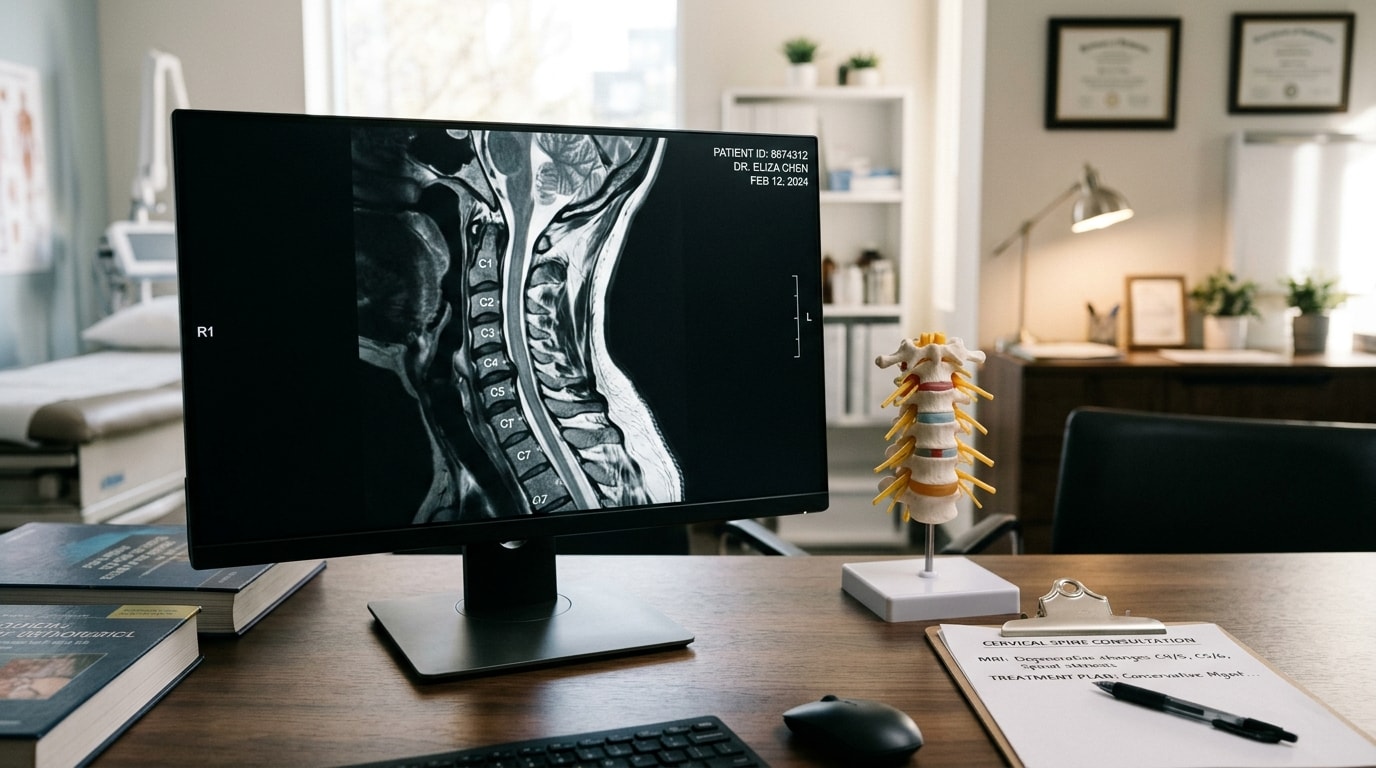
Cervical MRI is the gold standard for visualizing soft tissue damage. An MRI can detect ligament tears, disc bulges, annular tears, and edema in the cervical musculature. An MRI finding of a C5-C6 disc bulge with foraminal narrowing transforms your claim from a subjective pain complaint into an objectively documented structural injury.
Flexion-extension X-rays are dynamic films taken while you bend your neck forward and backward. They reveal ligamentous instability — abnormal movement between vertebrae that indicates the stabilizing ligaments have been compromised. This finding is particularly valuable because it documents a mechanical defect that cannot be faked.
Cervical CT with 3D reconstruction may be ordered when the MRI suggests bony involvement or when the treating physician needs to evaluate facet joint integrity.
Getting the right imaging early — within the first two to four weeks after the crash — is not optional. It is the foundation of your entire claim. Without it, the adjuster has no objective evidence to overcome, and the MIST program valuations prevail.
The treatment protocol that builds your settlement value
Consistent, documented medical treatment serves two purposes: it heals your injury, and it creates the medical paper trail that defeats the gap-in-treatment defense and establishes the severity of your condition.
The standard treatment protocol for documented whiplash follows a hierarchy. Physical therapy two to three times per week addresses range-of-motion deficits, muscular weakness, and postural dysfunction. Chiropractic care provides spinal manipulation to restore cervical alignment and reduce nerve compression. Both create dated treatment notes documenting your symptoms, functional limitations, and progress at every visit.
When conservative care fails to resolve symptoms after eight to twelve weeks, the treating physician escalates to orthopedic specialist referral. An orthopedist in the Victorville or Inland Empire area evaluates whether trigger point injections, cervical epidural steroid injections, or medial branch blocks are appropriate. Each escalation in the treatment hierarchy documents a more severe injury and generates higher medical specials — the actual dollars spent on treatment that form the baseline of your settlement calculation.
The critical rule: do not stop treating because you feel slightly better. Insurance adjusters monitor treatment frequency. If you attended physical therapy three times per week for six weeks and then abruptly stopped, the adjuster argues you were healed at week six — and everything after that point is unrelated to the crash.
What whiplash claims are actually worth in California
The insurance industry wants you to believe whiplash is worth $1,500 to $3,000. That range reflects their MIST program targets for undocumented, under-imaged, undertreated soft tissue claims with gaps in care. It does not reflect the actual value of a properly documented whiplash injury under California law.
Whiplash claims with cervical MRI findings (disc bulge, ligament tear, edema) and consistent treatment through physical therapy and chiropractic care — typically producing $8,000 to $15,000 in medical specials — command general damages multipliers of 3x to 5x the medical specials in San Bernardino County. That translates to total settlement ranges of $25,000 to $75,000 for moderate whiplash with objective imaging findings.
Cases that escalate to orthopedic intervention (injections, nerve blocks, or referral for surgical consultation) push into six-figure territory because the treatment hierarchy documents a severity level that the adjuster's MIST program cannot dismiss.
The National Library of Medicine (opens in new tab) classifies whiplash as a legitimate injury with potential for chronic symptoms. A Victorville car accident lawyer who handles whiplash cases understands that the difference between a $2,000 offer and a $50,000 settlement is not the severity of your pain — it is the quality of your medical documentation. Victims who accept the first settlement offer almost always leave significant money on the table, and understanding how long insurance claims take to settle helps you resist the pressure to close your case before treatment is complete.
This resource is independent and free to use. It is not a law firm and does not provide legal advice. For advice about your specific situation, speak with a qualified attorney.