Broken Bones Car Accident Settlement in California
California broken bones settlement guide: simple fractures vs. ORIF surgery, how titanium hardware elevates settlement multipliers, and medical liens for surgery without upfront costs.
- By
- Victorville PI Resource Editorial Team
- Published
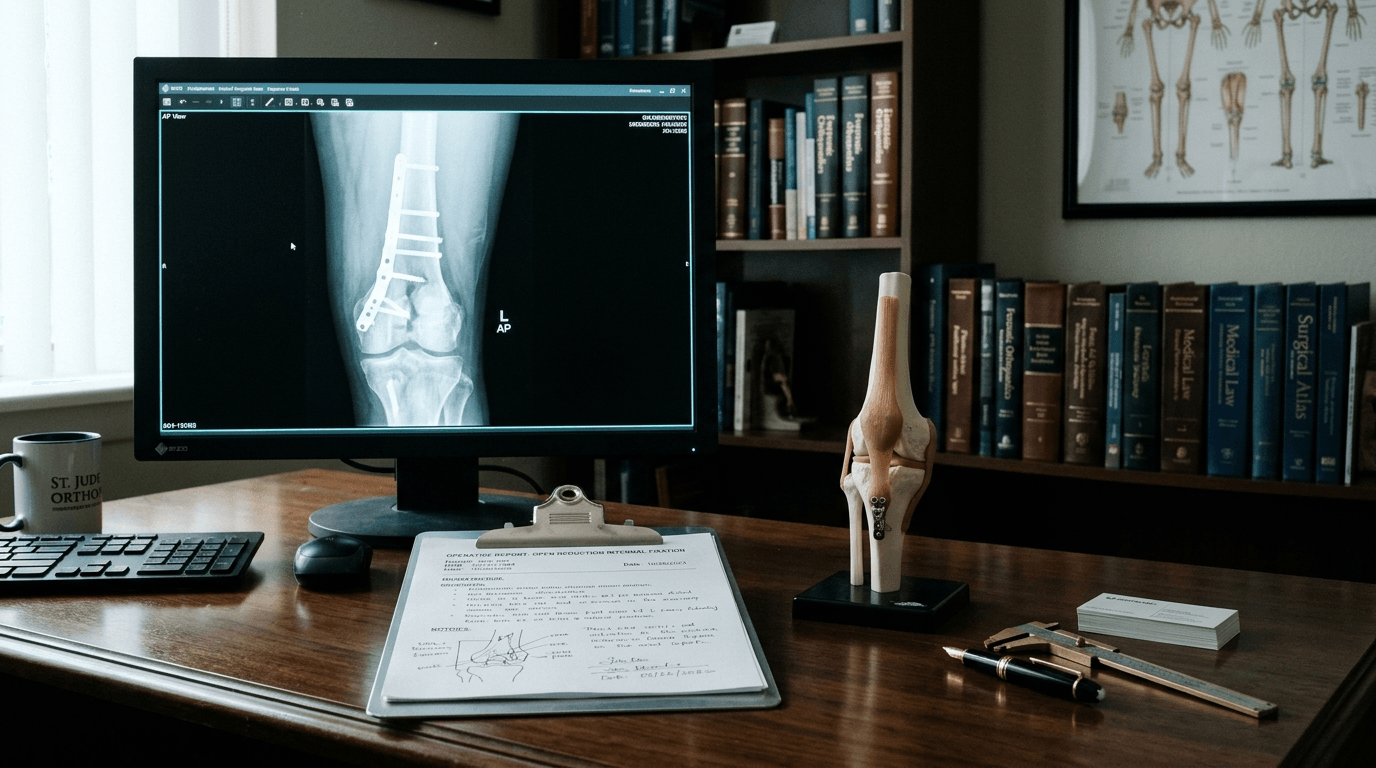
The X-ray confirmed it: a fracture. Whether it is a shattered wrist, a broken femur, a fractured pelvis, or a compound tibia-fibula break, the orthopedic surgeon is already discussing titanium plates, screws, or intramedullary rods. You know this is serious — but the insurance adjuster on the other end of the phone is already framing their narrative: "Fractures heal. Full recovery is expected." That framing is designed to suppress your claim value by ignoring the permanent consequences of surgical hardware implanted in your body. California personal injury law does not treat a fracture requiring surgery the same as a fracture treated with a cast, and understanding why is critical to recovering what your injury is actually worth.
Simple fractures vs. complex orthopedic fractures — why the distinction matters for your settlement
Not all broken bones produce the same claim value. The distinction between a simple fracture and a complex fracture requiring surgical intervention creates an enormous gap in settlement outcomes.
A simple, non-displaced fracture — a clean break where the bone fragments remain aligned — is treated with a cast, splint, or walking boot. The bone heals over six to eight weeks, physical therapy restores range of motion, and the patient returns to baseline function. Insurance adjusters value these cases at 1.5x to 2.5x the medical specials, producing settlements in the $10,000 to $30,000 range for typical cast-only fractures with moderate PT.
A complex fracture changes everything. Comminuted fractures (bone shattered into multiple fragments), compound/open fractures (bone penetrating through the skin), displaced fractures (bone fragments separated and misaligned), and intra-articular fractures (breaks extending into the joint surface) all require surgical intervention to restore anatomical alignment.
The surgical procedure for most complex fractures is Open Reduction Internal Fixation (ORIF) — an operation in which the orthopedic surgeon manually realigns the bone fragments (open reduction) and secures them with titanium plates, screws, and/or intramedullary rods (internal fixation). This hardware remains in the body permanently in most cases. The presence of permanent surgical hardware fundamentally transforms the claim from a "fracture that healed" into a "surgical implant case with permanent orthopedic consequences."
High-impact fracture types common in High Desert collisions
High-speed collisions on the I-15, Highway 395, Bear Valley Road, and other High Desert corridors produce characteristic fracture patterns driven by the specific collision dynamics.
Dashboard knee impact → acetabular and hip fractures: In frontal collisions, the driver's or passenger's knee slams into the dashboard, driving the femur backward into the hip socket. This mechanism produces acetabular fractures (fracture of the hip socket), femoral head fractures, and posterior hip dislocations. These injuries almost always require ORIF surgery and frequently produce permanent arthritis that may require total hip replacement within 10 to 15 years — a future surgery cost that is a compensable damage element.
Steering wheel impact → wrist and scaphoid fractures: When a driver braces against the steering wheel during impact, the force transmits through the wrists. Distal radius fractures (Colles fractures) and scaphoid fractures are common results. Scaphoid fractures are particularly dangerous because the scaphoid bone has a tenuous blood supply — undiagnosed or improperly treated scaphoid fractures can lead to avascular necrosis (bone death), requiring complex reconstruction surgery months after the initial injury.
Pedestrian lower-leg crush → tibia-fibula compound fractures: Pedestrians struck by vehicles on High Desert intersections absorb bumper-height impact forces directly to the lower legs. The resulting compound tibia-fibula fractures frequently involve bone penetrating through the skin, creating infection risks that complicate surgical repair. These injuries may require multiple surgeries: initial ORIF, followed by bone grafting, and potentially hardware removal — each generating additional medical specials and extending the treatment timeline.
T-bone impact → pelvic ring fractures: Side-impact collisions at uncontrolled intersections drive the door structure into the occupant's pelvis. Pelvic ring fractures are among the most debilitating orthopedic injuries, often requiring extended non-weight-bearing periods, complex ORIF with multiple plates, and months of intensive physical therapy. Pelvic fractures frequently produce chronic pain that permanently limits sitting tolerance, walking endurance, and sexual function — all compensable non-economic damages.
Why surgical hardware permanently elevates your settlement multiplier
Insurance adjusters want you to believe that once the bone heals, the injury is over. Orthopedic science disagrees.
Titanium plates, screws, and rods implanted during ORIF surgery create permanent consequences that persist for the rest of the patient's life. The hardware causes chronic inflammation at the implant-bone interface. Patients commonly report weather-induced aching — deep, dull pain in the hardware site that intensifies with barometric pressure changes, cold temperatures, and humidity shifts. In the High Desert, where temperature swings can exceed 40 degrees in a single day, this effect is particularly pronounced.
Joint stiffness and range-of-motion loss are expected permanent outcomes of fractures involving joint surfaces. An acetabular fracture repaired with ORIF will never produce a hip joint with the same range of motion as the uninjured hip. A distal radius fracture with plate fixation permanently limits wrist flexion and grip strength. These functional limitations are documented through permanent impairment ratings assigned by an orthopedic evaluator using the AMA Guides to the Evaluation of Permanent Impairment.
Future hardware removal surgery is a separate, compensable damage element. While not all hardware requires removal, plates and screws that cause soft tissue irritation, tendon impingement, or chronic pain at the implant site frequently need to be surgically extracted — a second operation that generates additional medical costs, recovery time, and pain and suffering damages.
The combination of permanent hardware, documented impairment, and potential future surgery pushes the general damages multiplier from the 1.5-2.5x range (cast-only fractures) to the 3x-5x range (ORIF surgical cases). On a case with $40,000 to $80,000 in medical specials (ER, surgery, hospitalization, PT, orthopedic follow-ups, imaging), that multiplier difference translates to settlements of $120,000 to $400,000 for surgical fracture cases versus $15,000 to $40,000 for cast-only fractures. The hardware is literally worth six figures.
Medical liens: getting surgery without paying out of pocket
Many fracture victims face an agonizing financial trap: they need ORIF surgery immediately, but they have no health insurance or their insurance imposes deductibles and co-pays they cannot afford. The at-fault driver's insurance will not pay a single dollar until the case is fully resolved — which may take 12 to 24 months. Without surgery, the bone heals improperly (malunion), producing chronic pain and functional disability that no future surgery can fully correct.
Medical liens (Letters of Protection) solve this problem. Under a medical lien arrangement, an orthopedic surgeon agrees to perform the surgery and defer payment until the personal injury case settles. The surgeon's fees are paid from the final settlement proceeds. The patient receives immediate surgical care — from premier Inland Empire orthopedic specialists — without paying anything out of pocket during the case.
Insurance adjusters fear medical lien cases because the lien signals that the claim has escalated beyond soft tissue. A surgeon who performs ORIF on a lien has skin in the game — they need the case to settle at a value that covers their surgical fees, which means they will provide detailed operative reports, impairment ratings, and trial testimony if needed. Understanding who pays medical bills while waiting for a settlement ensures you do not delay surgery out of financial fear and destroy your own claim in the process.
What broken bone settlements are worth in California
Settlement values for fracture cases vary dramatically based on fracture complexity, surgical intervention, and permanent impairment.
Cast-only fractures with moderate physical therapy: $10,000 to $35,000. Single-site ORIF surgery (one plate, one fracture location) with documented impairment: $75,000 to $200,000. Multi-site or complex ORIF (multiple fractures, multiple surgeries, or fractures involving joint surfaces): $150,000 to $400,000. Catastrophic fractures with permanent disability (pelvic ring fractures, bilateral femur fractures, fractures with vascular damage requiring amputation): $500,000 to $1,000,000+.
The American Academy of Orthopaedic Surgeons (opens in new tab) confirms that complex fractures involving joint surfaces produce lifelong arthritis and functional limitation — outcomes that California law compensates through general damages for permanent impairment. A Victorville car accident lawyer experienced in orthopedic injury cases coordinates surgical liens, documents permanent impairment, and presents the lifetime consequences of surgical hardware in a format that pushes settlement offers beyond the adjuster's initial lowball range. Understanding realistic California car accident settlement values provides a baseline for evaluating whether the adjuster's offer reflects the actual severity of your fracture.
This resource is independent and free to use. It is not a law firm and does not provide legal advice. For advice about your specific situation, speak with a qualified attorney.