Knee Injury Car Accident Settlement in California
California knee injury settlement guide: dashboard knee mechanism, ACL/PCL/meniscus tears, arthroscopic reconstruction surgery, post-traumatic arthritis, and medical liens for surgery without upfront costs.
- By
- Victorville PI Resource Editorial Team
- Published
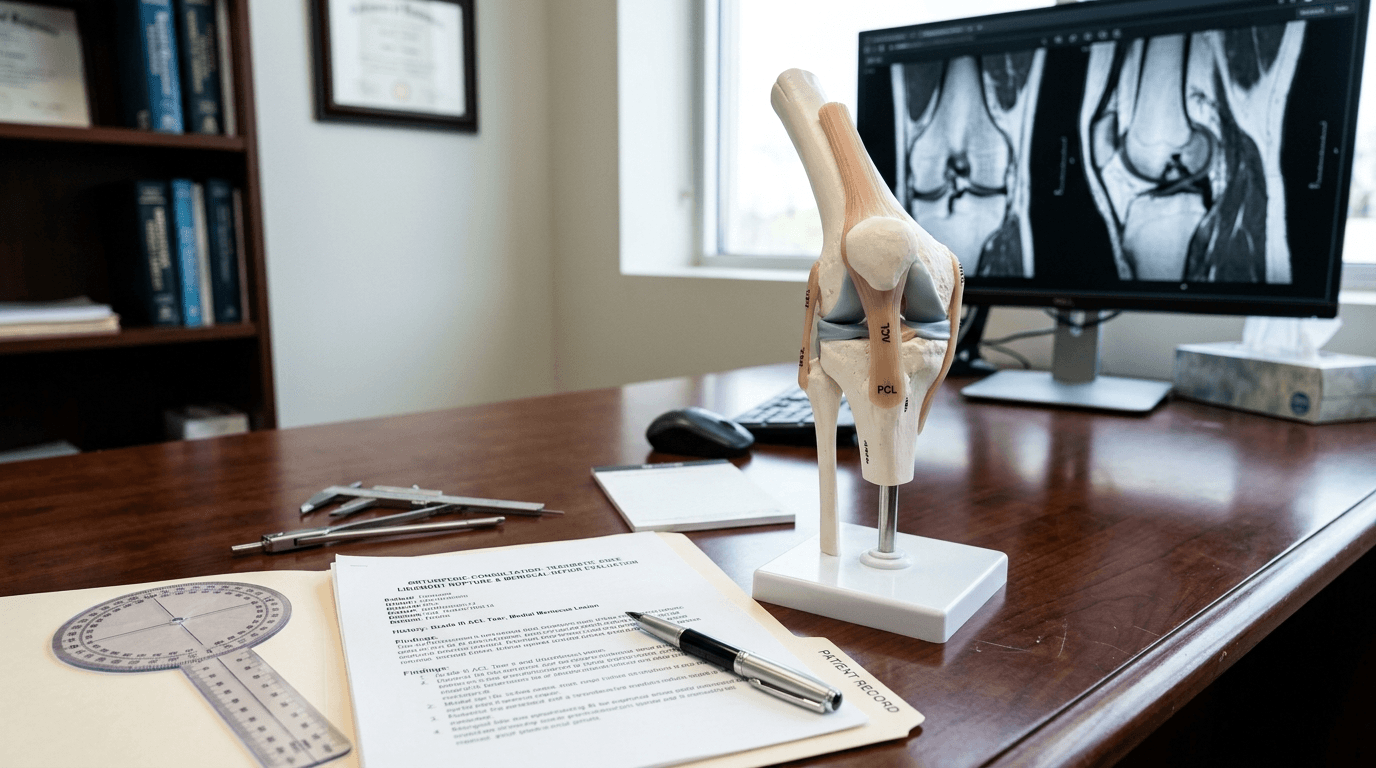
The dashboard knee injury is one of the most predictable crash injury patterns in California personal injury medicine — and one of the most aggressively undervalued by insurance adjusters. In frontal and rear-end collisions, the occupant's knee drives forward into the dashboard at the moment of impact. The force transmits through the tibia, stresses the cruciate ligaments, compresses the menisci, and in severe impacts, shatters the patella against the dashboard surface. If your MRI revealed an ACL tear, PCL rupture, meniscus tear, or complex of multiple injuries, the adjuster's valuation of your claim likely does not reflect what the surgical treatment, the recovery timeline, or the long-term arthritis risk will actually cost you.
The dashboard knee mechanism — what happens at the moment of impact
Understanding the biomechanics of the dashboard knee injury explains why these injuries consistently require surgical intervention and produce permanent consequences.
In a frontal collision, the occupant's body continues moving forward at the pre-impact speed after the vehicle stops. The knees — positioned directly in front of the dashboard — absorb this forward momentum through direct contact with the dashboard surface. The impact drives the tibia anteriorly (forward) relative to the femur, loading the posterior cruciate ligament (PCL) — which resists this specific tibial movement. High-force frontal impacts produce PCL ruptures that, in isolation, may be treated conservatively, but in combination with other knee structures, require surgical reconstruction.
In a rear-end collision, the occupant is thrown backward and then forward in rapid sequence. The forward-throw phase drives the knee into the dashboard with the hip and knee at specific flexion angles that load the anterior cruciate ligament (ACL). ACL ruptures in crash victims follow the same mechanism as sports ACL tears — sudden valgus and rotational stress — and require identical surgical treatment.
Meniscus injuries occur through compressive and rotational loading at the moment of impact. The medial and lateral menisci — the C-shaped cartilage discs that cushion and stabilize the knee joint — can tear radially, horizontally, or in complex patterns (bucket-handle tears) that cause mechanical symptoms: locking, catching, giving way, and inability to fully extend or flex the knee.
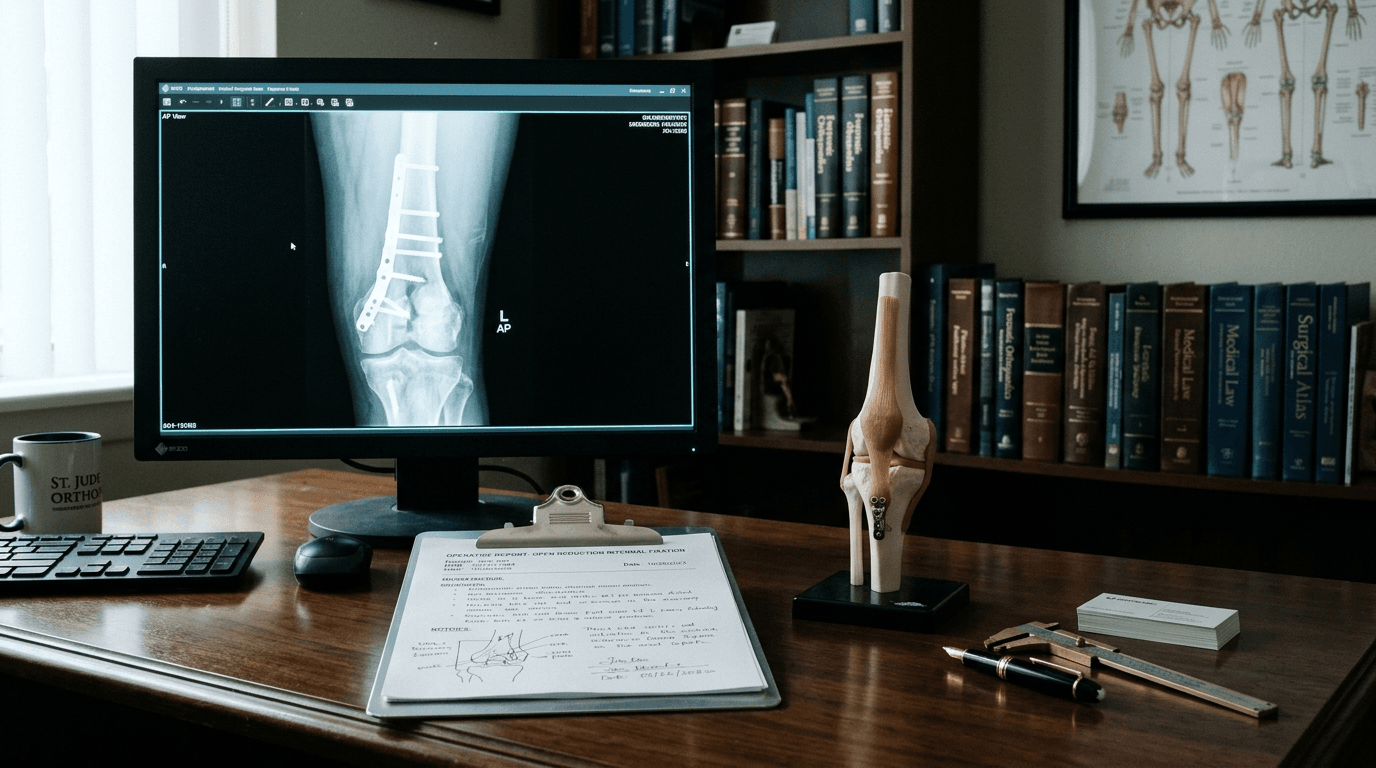
Patellar fractures occur in high-energy direct impacts where the kneecap strikes the dashboard surface. Comminuted patellar fractures require ORIF surgery with tension band wiring or cannulated screws, followed by six to eight weeks of immobilization and months of intensive physical therapy.
Combined multi-ligament injuries — ACL plus PCL, or ACL plus medial collateral ligament (MCL) — represent the most severe dashboard knee pattern. These injuries require staged surgical reconstruction and produce the most prolonged recovery timelines and highest risk of permanent functional limitation.
Why knee MRI alone may not capture the full injury picture
Standard supine (lying down) knee MRI — performed with the patient flat and the knee unloaded — can underestimate meniscus tear severity and miss cartilage damage that only becomes apparent under weight-bearing conditions.
Weight-bearing MRI (performed in an upright MRI unit with the patient standing) loads the joint surfaces under physiological conditions and reveals cartilage compression injuries, joint space narrowing, and meniscal extrusion that are invisible on standard supine MRI. While not universally available, weight-bearing MRI provides a more clinically accurate picture of the injury in cases where symptoms exceed what standard imaging shows.
MRI arthrogram (intra-articular contrast injection followed by MRI) dramatically improves detection of partial-thickness cartilage defects, labral-equivalent injuries, and subtle meniscal tears that standard MRI misses. When symptoms are significant and standard MRI appears disproportionately normal, arthrogram MRI is the appropriate next step.
Diagnostic arthroscopy — a minimally invasive surgical procedure that allows direct visualization of the joint interior — remains the gold standard for definitively assessing articular cartilage integrity, meniscal tear patterns, and ligament damage. Some surgeons proceed directly to arthroscopic surgery when the clinical picture and standard MRI are consistent with significant injury, using the diagnostic arthroscopy as the first step of the therapeutic procedure.
Getting the appropriate imaging and specialist evaluation is not optional — it is the foundation of the medical documentation that transforms a subjective pain complaint into an objectively proven structural injury.
Arthroscopic reconstruction versus conservative management — and what the difference costs
The treatment pathway for crash-related knee injuries determines both the recovery trajectory and the settlement value.
Conservative management (physical therapy, bracing, corticosteroid injections) may be appropriate for isolated low-grade MCL sprains, stable partial meniscus tears in older low-demand patients, and bone bruises without structural disruption. Medical specials for conservative management: $8,000 to $18,000.
Arthroscopic meniscus surgery — either repair (suturing a torn meniscus) or partial meniscectomy (removing the torn fragment) — is the most common surgical intervention for crash-related meniscus tears. Repair is preferred when the tear pattern and blood supply allow healing; meniscectomy is performed when the tear is irreparable. Arthroscopic meniscus surgery costs $25,000 to $50,000 in facility and physician fees, with physical therapy adding $5,000 to $10,000 over three to four months of recovery.
ACL reconstruction using a patellar tendon, hamstring tendon, or allograft replaces the torn ACL with a graft that the body gradually incorporates over 12 to 18 months. Surgery costs $40,000 to $75,000 in total fees. Recovery requires 9 to 12 months before return to full unrestricted activity — during which the patient cannot run, pivot, or perform demanding physical work. For High Desert workers in construction, logistics, law enforcement, or military roles, that 9-to-12-month functional limitation represents significant lost wages.
Multi-ligament reconstruction — the most complex knee surgery — requires staged procedures addressing each ligamentous structure sequentially, with total costs exceeding $100,000 to $150,000 and recovery timelines of 18 to 24 months.
The long-term arthritis risk — and why it adds to your settlement demand
Insurance adjusters treat knee injuries as finite events: surgery happens, recovery occurs, and the claim closes. This ignores the most significant long-term consequence of crash-related knee injuries: post-traumatic osteoarthritis (PTOA).
When articular cartilage — the smooth, hyaline cartilage that covers joint surfaces — is damaged in a crash through direct impact, compressive loading, or instability from torn ligaments, the cartilage does not regenerate. The damaged area deteriorates progressively over years, producing joint space narrowing, bone-on-bone friction, chronic pain, and mechanical dysfunction.
The statistics are clear and well-documented in orthopedic literature: within 10 to 20 years of an ACL tear, over 50 percent of patients develop radiographic evidence of post-traumatic osteoarthritis regardless of whether ACL reconstruction was performed. Meniscal damage — especially partial meniscectomy that removes the shock-absorbing cartilage — accelerates articular cartilage breakdown and PTOA development even faster.
The endpoint of PTOA is total knee replacement (TKR) — a $30,000 to $60,000 surgical procedure with a prosthetic lifespan of 15 to 25 years, meaning a 35-year-old crash victim may require two to three knee replacements over their remaining lifetime. These future costs are compensable in a California personal injury claim as damages for future medical expenses. An orthopedic expert who testifies to the probability and timing of future TKR — based on the patient's current cartilage damage, age, activity level, and meniscal status — converts this future cost into a present-value damages element that significantly increases the total settlement demand.
Medical liens — getting reconstruction surgery without paying out of pocket
Many crash victims with serious knee injuries face the same financial trap as other orthopedic injury victims: they need surgery immediately to prevent permanent functional decline, but they cannot afford it and the at-fault driver's insurance will not pay a dime until the case settles.
Medical liens solve this problem for knee injury cases exactly as they do for fractures and rotator cuff tears. A board-certified orthopedic surgeon — specializing in sports medicine and joint reconstruction — agrees to perform the ACL or meniscal repair surgery, defer their fees, and accept payment from the eventual settlement proceeds. The patient receives high-quality surgical care from a top Inland Empire orthopedist without a dollar in upfront costs.
The practical consequence: a crash victim with a torn ACL can have surgery within 30 days of the crash regardless of their insurance status or financial situation. This matters because delaying ACL reconstruction beyond three to six months from the injury allows secondary damage to accumulate — meniscal tears from the unstable joint, cartilage erosion from bone-on-bone contact, and muscular atrophy that complicates post-surgical rehabilitation.
What knee injury settlements are worth in California
Conservative management only (PT, injections): $20,000 to $50,000. Arthroscopic meniscus surgery: $60,000 to $120,000 total settlement. ACL reconstruction with full recovery: $80,000 to $175,000. Multi-ligament reconstruction or combined ACL/meniscus surgery: $150,000 to $350,000. Cases with documented post-traumatic arthritis and future TKR projection: $200,000 to $500,000+.
A Victorville car accident lawyer experienced in orthopedic injury cases arranges surgical liens with qualified Inland Empire knee reconstruction specialists, retains orthopedic experts to document future TKR probability, and uses the same documentation strategy that produces strong results in broken bone cases. Understanding how long California injury claims take to resolve prevents victims from accepting premature low offers before the full extent of their cartilage damage and arthritis risk has been evaluated.
This resource is independent and free to use. It is not a law firm and does not provide legal advice. For advice about your specific situation, speak with a qualified attorney.