What to Do After a Car Accident in Lucerne Valley, CA
Lucerne Valley crash guide: SR-18 and SR-247 mining truck hazards, Mitsubishi Cement haulers, air ambulance medevac, and how to build your injury claim.
- By
- Victorville PI Resource Editorial Team
- Published
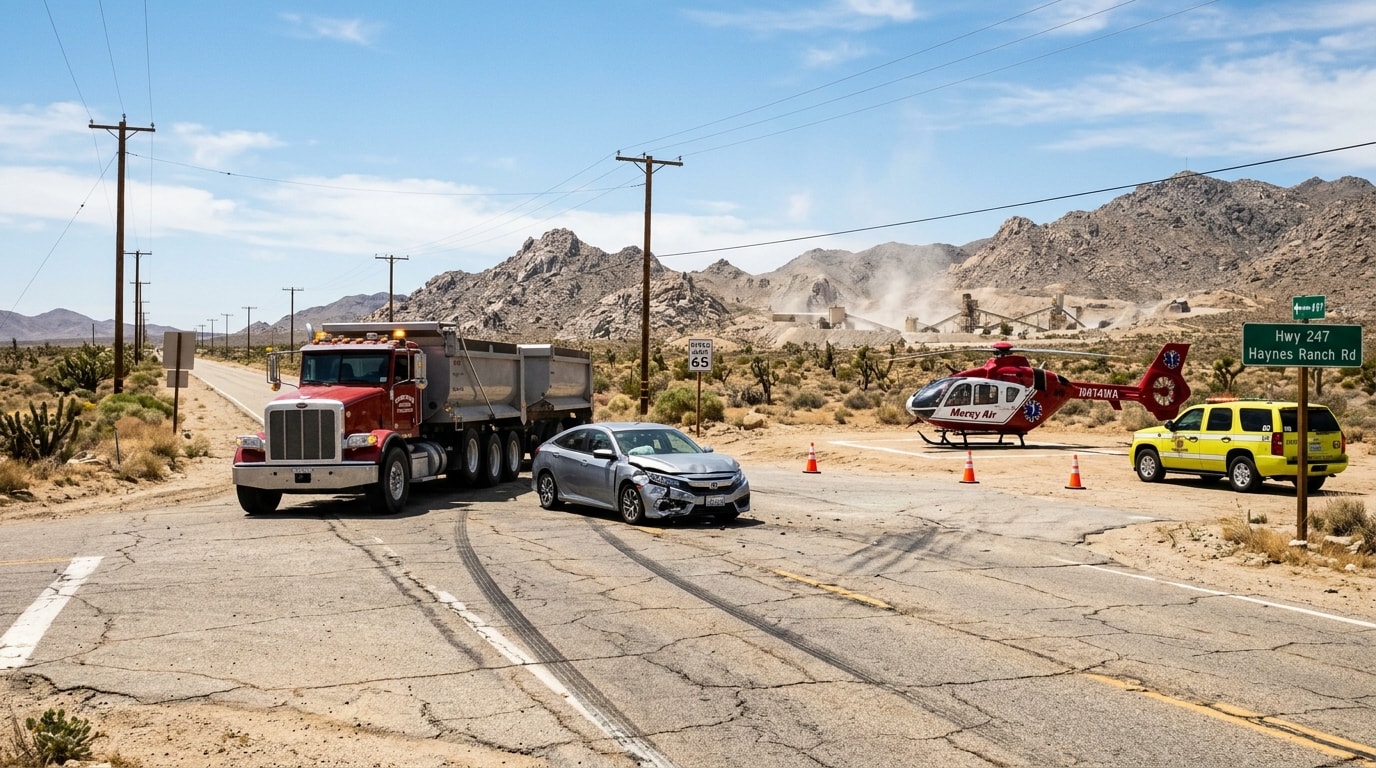
Lucerne Valley is a remote eastern High Desert crossroads where State Route 18 and State Route 247 (Old Woman Springs Road / Barstow Road) converge. This intersection serves as the gateway between Apple Valley, Barstow, and the mountain communities around Big Bear — and it channels an extraordinary mix of heavy industrial mining trucks, weekend recreational traffic, and local residents onto two-lane desert highways never designed for that volume. If you were involved in a crash on one of these corridors, the complexity of your claim likely exceeds a standard car accident.
Why Lucerne Valley is one of the most dangerous crossroads in the High Desert
The collision dynamics in Lucerne Valley are driven by a fundamental mismatch: heavy commercial vehicles operating on roads designed for light rural traffic. The cement and mineral mining operations that anchor the local economy — including Mitsubishi Cement Corporation and Omya California — generate a constant flow of double-bottom dump trucks, mining haulers, and aggregate carriers along SR-18 and SR-247.
These commercial vehicles share the road with weekend tourists heading to Big Bear Lake, recreational off-highway vehicle (OHV) trailers, and local residents in passenger cars. The speed differential between a loaded dump truck climbing a grade at 35 mph and a sedan traveling at the posted 55 mph creates dangerous passing situations on undivided two-lane stretches.
The terrain compounds the problem. Long straight desert stretches give drivers a false sense of security, encouraging high-speed travel. When those straight stretches terminate at blind intersections or transition into curves, drivers who maintained excessive speed cannot stop in time — especially when a 60,000-pound loaded aggregate hauler occupies the opposing lane.
The commercial vehicle hazard: dump trucks, mining haulers, and aggregate carriers
Crashes involving commercial mining and hauling vehicles follow a fundamentally different liability framework than passenger-vehicle-only collisions. When a Mitsubishi Cement double-bottom dump truck or an Omya aggregate hauler is involved, the claim potentially reaches multiple defendants with separate insurance policies.
The truck driver may be liable for negligence — speeding, fatigue, failure to maintain lane position, or running a stop sign at an uncontrolled intersection. The motor carrier (the trucking company) may be liable under respondeat superior for the driver's conduct during employment, and independently liable for negligent hiring, inadequate training, or failure to enforce hours-of-service regulations.
The mine operator or shipper may share liability if they overloaded the vehicle beyond its gross vehicle weight rating, improperly secured the cargo, or pressured the driver to make runs on a schedule that violated federal hours-of-service limits. Each defendant's insurance policy adds to the available pool of recovery — and commercial carriers operating in California are required by the FMCSA (opens in new tab) to carry minimum coverage of $750,000 to $5,000,000 depending on the cargo classification.
Emergency response in California's most remote desert corridors
Lucerne Valley is one of the most medically isolated communities in San Bernardino County. Law enforcement jurisdiction falls primarily under the California Highway Patrol (CHP) Victorville Area Office, with the SBCSD Lucerne Valley Substation assisting on local roads and providing initial scene security until CHP arrives.
The critical challenge is trauma transport time. Ground ambulance from a crash scene on SR-247 near Rabbit Springs Road to Apple Valley takes over 45 minutes. Transport to Loma Linda University Medical Center — the nearest Level I trauma center — exceeds 75 minutes by ground. For patients with suspected spinal cord injury, severe internal bleeding, or traumatic brain injury, those minutes translate directly into survival probability.
REACH Air Ambulance and Mercy Air medevac helicopters operate from designated desert landing pads in the Lucerne Valley area. Air transport cuts the time to definitive trauma care from over an hour to approximately 20 minutes. The cost of helicopter medevac — typically $40,000 to $80,000 per flight — is a recoverable special damage in your injury claim and is added to the total that the at-fault party's insurance must pay.
Dangerous intersections and crash patterns
The intersection of SR-18 and Barstow Road (SR-247) is the highest-risk collision point in Lucerne Valley. This junction handles converging traffic from three directions — westbound from Barstow, southbound from Apple Valley, and eastbound from Big Bear — with limited traffic controls. T-bone collisions at this intersection frequently involve a commercial vehicle striking a passenger car broadside.
Rabbit Springs Road intersects SR-18 at a point where eastbound drivers are accelerating after the SR-247 junction, creating a speed trap for local residents turning onto the highway. The lack of acceleration lanes, turn signals, and adequate sight distances at these rural intersections produces crashes that would not occur on properly engineered roads.
Weekend traffic surges create a seasonal hazard pattern. Friday afternoons and Sunday evenings bring heavy recreational traffic — trucks towing boats, RVs, and OHV trailers — through corridors already stressed by industrial truck volumes. The mix of unfamiliar weekend drivers with experienced commercial haulers on narrow two-lane desert highways is a recipe for catastrophic multi-vehicle collisions.
How to protect your claim in a remote Lucerne Valley crash
Evidence preservation in Lucerne Valley requires urgency. There are no traffic cameras, no intersection surveillance systems, and no commercial properties with security footage along most of SR-18 and SR-247. Desert wind erases skid marks within days and redistributes debris fields. If you are physically able, photograph everything at the scene — vehicle positions, road conditions, any commercial vehicle markings or DOT numbers, and cargo that may have spilled or shifted.
If a commercial truck was involved, record the USDOT number and motor carrier number displayed on the truck's cab door. These numbers allow your attorney to pull the carrier's safety record, inspection history, and insurance information through the FMCSA Safety Measurement System before the carrier's legal team has time to prepare a defense.
A Victorville truck accident lawyer experienced in commercial vehicle crashes understands the multi-defendant liability framework that applies to mining corridor collisions. The claim-building process for Lucerne Valley crashes shares elements with accidents in Apple Valley and along the I-15 through Barstow — but the industrial truck component and the extreme medical isolation add layers of complexity that require immediate legal action.
This resource is independent and free to use. It is not a law firm and does not provide legal advice. For advice about your specific situation, speak with a qualified attorney.