California Commercial Truck Accident Claims Guide
A comprehensive guide to California commercial truck accident claims: FMCSA regulations, Hours of Service, identifying liable parties, negligent hiring, and preserving critical evidence.
- By
- Victorville PI Resource Editorial Team
- Published
A collision with a commercial truck is not just a more severe version of a car accident — it is a fundamentally different type of case. The vehicles are governed by an entirely separate body of federal law. The driver is rarely the only party responsible. The evidence is more complex, more voluminous, and more likely to disappear if it is not preserved quickly. And the injuries tend to be catastrophic, often involving long-term disability or death. This guide explains the legal and regulatory framework that makes commercial truck accident claims unique in California. It is general legal information, not legal advice.
Why truck accident claims are different
The physics alone set these cases apart. A fully loaded tractor-trailer can weigh up to 80,000 pounds — roughly twenty times the weight of a passenger car. At highway speeds, the kinetic energy involved in a collision is devastating. The occupants of the smaller vehicle absorb the vast majority of the impact force, which is why truck crashes produce a disproportionate share of catastrophic injuries: spinal cord damage, traumatic brain injuries, crush injuries, and fatalities.
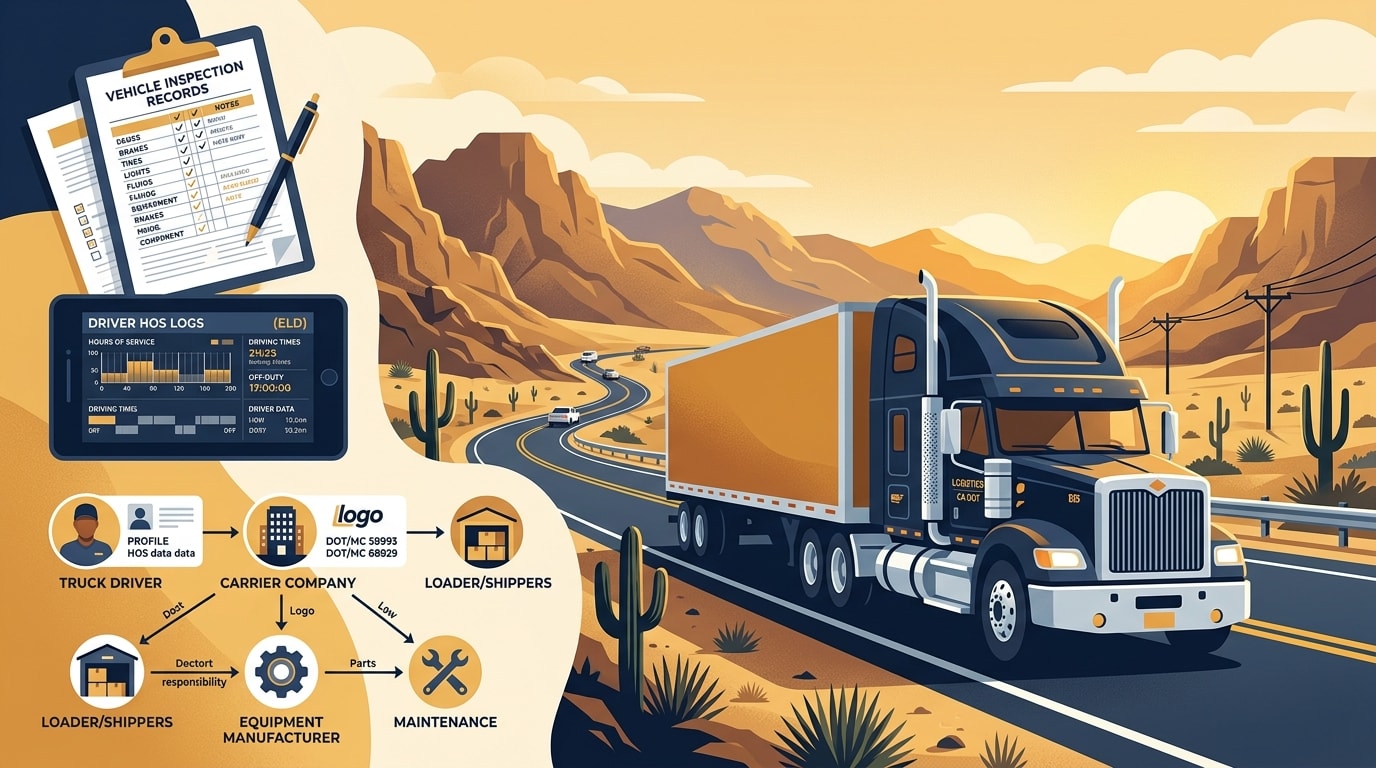
But the legal complexity is what truly distinguishes these cases. In a typical car accident, you are dealing with one other driver and one insurance policy. In a commercial truck case, you may be dealing with the driver, the trucking company, the company that loaded the cargo, the entity that maintained the vehicle, the manufacturer of a defective component, and potentially a freight broker who selected the carrier. Each party may carry separate insurance coverage, and each may bear a different share of responsibility.
Adding another layer, commercial trucks operating in interstate commerce are regulated by federal law — specifically, the rules enforced by the Federal Motor Carrier Safety Administration (FMCSA). Violations of these federal regulations can serve as powerful evidence of negligence, and in some cases, they can establish liability as a matter of law.
Federal regulations that govern commercial trucks
The FMCSA establishes a comprehensive regulatory framework covering virtually every aspect of commercial trucking operations. Understanding these rules is essential because violations often form the foundation of a truck accident claim.
Hours of Service (HOS). Driver fatigue is one of the leading causes of commercial truck crashes. To combat this, the FMCSA Hours of Service regulations under 49 CFR Part 395 (opens in new tab) impose strict limits on driving time. A property-carrying driver may drive a maximum of 11 hours after 10 consecutive hours off duty, and all driving must occur within a 14-hour window after coming on duty. After 8 consecutive hours of driving, a 30-minute break is required. There is also a 60/70-hour rule that limits total on-duty time over a rolling 7- or 8-day period.
Electronic Logging Devices (ELDs). Since December 2017, most commercial motor vehicles have been required to use ELDs to automatically record driving time. These devices replaced paper logbooks, which were easily falsified. ELD data is among the most important evidence in a truck crash case because it can reveal whether the driver exceeded legal driving limits in the hours before the collision.
Vehicle maintenance and inspection (49 CFR Part 396). Trucking companies are required to systematically inspect, repair, and maintain all commercial vehicles under their control. Drivers must conduct pre-trip and post-trip inspections and document any defects. Brake failures, tire blowouts, and lighting malfunctions caused by inadequate maintenance can make the trucking company directly liable for a crash.
Drug and alcohol testing (49 CFR Part 382). Commercial drivers are subject to mandatory pre-employment, random, post-accident, and reasonable-suspicion drug and alcohol testing. A positive test result — or evidence that a trucking company failed to conduct required testing — can be devastating to the defense.
Identifying all liable parties
One of the most consequential aspects of a truck accident case is determining who is responsible — and there are often more answers to that question than people expect.
The truck driver is the most obvious defendant. If the driver was speeding, fatigued, distracted, impaired, or violated traffic laws, they bear personal liability for the crash. But the driver is rarely the only party at fault, and they are almost never the party with the deepest insurance coverage.
The trucking company is often the most important defendant. Under the doctrine of respondeat superior, a trucking company is vicariously liable for the negligent acts of its drivers when those acts occur within the scope of employment. This applies regardless of whether the company itself did anything wrong. And if the company did act negligently — by hiring an unqualified driver, pressuring drivers to violate HOS rules, or failing to maintain its fleet — it faces direct liability as well.
Cargo loaders and shippers. If improperly loaded, unbalanced, or unsecured cargo caused the truck to become unstable — leading to a rollover, jackknife, or cargo spill — the party responsible for loading the freight may be liable. Federal regulations establish specific requirements for cargo securement, and violations create a clear path to liability.
Maintenance contractors. Many trucking companies outsource vehicle maintenance to third-party shops. If a brake failure, tire blowout, or steering malfunction is traced to negligent repair work, the maintenance provider can be brought into the case.
Vehicle and parts manufacturers. If a defective component — a faulty brake system, a defective tire, a malfunctioning coupling device — contributed to the crash, the manufacturer may be liable under California's strict product liability law.
Freight brokers. An increasingly recognized theory holds that freight brokers — the intermediaries who match shippers with carriers — may be liable if they negligently selected an unsafe or underinsured carrier.
Negligent hiring, retention, and supervision
Beyond respondeat superior, trucking companies can be held directly liable for their own failures in selecting, monitoring, and managing their drivers. These claims often produce the most significant damages because they reflect the company's own conscious disregard for safety.
Negligent hiring occurs when a trucking company fails to conduct adequate background checks before putting a driver behind the wheel. FMCSA regulations require carriers to investigate a driver's employment history, driving record, and safety performance history for the previous three years. A company that hires a driver with a history of HOS violations, DUI convictions, or serious moving violations — without investigating or despite knowing — can be held liable for negligent hiring.
Negligent retention applies when a company becomes aware of a driver's unsafe behavior — repeated violations, customer complaints, failed drug tests, at-fault crashes — and continues to employ them. The question is not whether the company knew, but whether it should have known through reasonable oversight.
Negligent supervision covers failures in ongoing management: tolerating log falsification, implicitly encouraging HOS violations through unrealistic delivery schedules, or failing to discipline drivers for documented safety infractions. When corporate records reveal a pattern of pressure to prioritize speed over safety, the resulting liability can extend beyond compensatory damages.
Understanding how California's comparative negligence system allocates fault among multiple parties is critical in these cases, because the percentage of responsibility assigned to each defendant directly determines how much each one pays.
Evidence that makes or breaks a truck accident case
Truck accident cases are won or lost on evidence — and the most critical evidence is often electronic, time-sensitive, and controlled by the defense.
ELD and event data recorder (EDR) data can reveal the driver's hours on duty, speed at the moment of impact, braking patterns, and whether the driver took required rest breaks. This data can be overwritten automatically as the truck continues to operate, which is why a spoliation letter — a formal demand to preserve all evidence — should be sent to the trucking company as quickly as possible after a crash.
Driver qualification files are maintained by the trucking company and contain the driver's employment application, driving record, medical certifications, drug and alcohol test results, and training documentation. These files are essential for negligent hiring and retention claims.
Maintenance and inspection records document every scheduled and unscheduled repair, every pre-trip and post-trip inspection report, and every known defect. Gaps in maintenance records — or evidence that known defects were not repaired — can establish direct negligence by the trucking company.
Dispatch and communication records can reveal whether the company pressured the driver to meet an unrealistic delivery schedule, effectively encouraging HOS violations.
For a detailed breakdown of what evidence to prioritize and how to preserve it, see our truck accident evidence checklist.
When a truck crash happens on a local freight corridor
Everything discussed in this guide applies with particular force along California's major freight corridors — and few corridors carry more commercial truck traffic than Interstate 15 through the Cajon Pass and the High Desert.
The I-15 is one of the primary arteries connecting the Southern California logistics network — the ports of Los Angeles and Long Beach, the Inland Empire warehouses — with distribution hubs in Las Vegas and across the western United States. The volume of truck traffic on this corridor is immense, and the terrain adds risk: the steep grades through the Cajon Pass, the high-speed transition zones through Victorville, and the merging patterns at major interchanges all create conditions where fatigue, mechanical failure, and driver error can have catastrophic consequences.
When a commercial truck crash occurs along this corridor, the specific patterns and risks of I-15 truck accidents in Victorville become directly relevant — including the role of driver fatigue on long-haul routes, the prevalence of brake failures on downhill grades, and the challenges of navigating transition zones where highway speeds meet local traffic.
Understanding how commercial truck accident claims are investigated and pursued in California matters because these cases require a different approach than standard car accident claims — more parties, more evidence, more regulation, and significantly higher stakes.
This resource is independent and free to use. It is not a law firm and does not provide legal advice. For advice about your specific situation, speak with a qualified attorney.