Burn Injury Car Accident Settlement in California
California burn injury settlement guide: second and third-degree burns, skin graft surgery, Arrowhead Regional Burn Center, product liability claims against auto manufacturers, and multi-million dollar recovery.
- By
- Victorville PI Resource Editorial Team
- Published
Severe burn injuries from vehicle fires, ruptured fuel lines, and battery explosions following High Desert collisions represent the most physically agonizing injuries in California personal injury law — and among the most legally complex. The medical journey from the crash scene through months of wound debridement, skin grafting, and contracture release surgery produces astronomical special damages. The liability analysis extends far beyond the at-fault driver, reaching into product liability claims against vehicle manufacturers whose fuel system or battery design contributed to the post-crash fire. If your loved one is in the Arrowhead Regional Medical Center Burn Center right now, understanding the full scope of the legal claim cannot wait.
How vehicle fires and thermal injuries occur in High Desert crashes
Post-crash vehicle fires are not random events — they result from specific mechanical failures that engineers and safety regulators have identified, studied, and in many cases, failed to adequately address.
Ruptured fuel lines and fuel tanks are the most common cause of post-crash vehicle fires. High-speed collisions on I-15 or Highway 395 generate impact forces that can rupture the fuel tank, fuel filler neck, or fuel supply lines. Gasoline that contacts hot engine components or electrical sparks from the crash ignites within seconds. Federal Motor Vehicle Safety Standard (FMVSS) 301 regulates fuel system integrity — vehicles that fail to meet this standard in crash conditions are subject to product liability claims against the manufacturer.
Battery explosions have emerged as a specific hazard in hybrid and electric vehicles. High-voltage lithium-ion battery packs that are damaged in a collision can enter thermal runaway — a cascade reaction in which damaged battery cells generate heat that causes adjacent cells to fail, producing temperatures exceeding 1,000°F and fires that are extremely difficult to extinguish with conventional suppression methods. Emergency responders in the High Desert may be unequipped for lithium battery fires, prolonging victim exposure.
Airbag chemical burns from sodium azide and other propellant compounds cause chemical burn injuries distinct from thermal burns — the mechanism is direct chemical contact rather than heat, and the injuries can deepen over hours as the chemical continues reacting with skin tissue.
Contact with hot engine components occurs when the crash forces an occupant into contact with the engine block, exhaust system, or superheated coolant — particularly in motorcycle accidents or crashes where the engine intrudes into the occupant compartment.
Burn classification and the treatment pathway
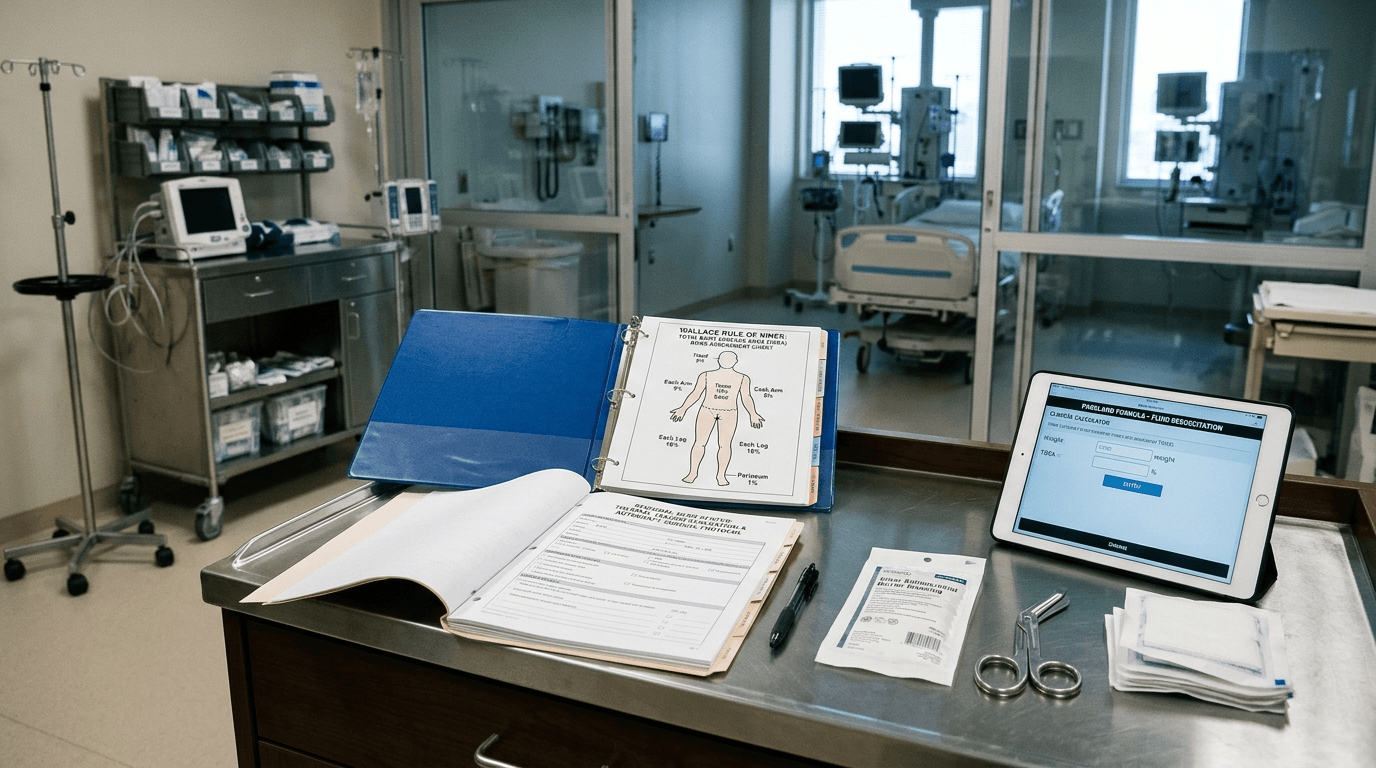
Burn severity is classified by the depth of tissue destruction, and each classification level produces dramatically different medical costs and permanent consequences.
Second-degree partial-thickness burns destroy the epidermis and part of the dermis but preserve the deeper dermal layers. These burns are exquisitely painful because nerve endings remain intact in the surviving dermis. They typically heal with aggressive wound care — daily or twice-daily debridement (removal of dead tissue), application of antimicrobial dressings, and infection monitoring — over two to six weeks. Large partial-thickness burns may require split-thickness skin grafting to accelerate healing and reduce scarring.
Second-degree deep partial-thickness burns extend into the deeper dermis, destroying most of the dermal appendages (hair follicles, sweat glands) that enable spontaneous re-epithelialization. These burns universally require surgical skin grafting and produce permanent hypertrophic or contracted scarring.
Third-degree full-thickness burns destroy the entire dermis down to subcutaneous fat or deeper — into muscle or bone in the most severe cases. The burned area is typically insensate (no pain) because the nerve endings have been destroyed. Full-thickness burns cannot heal by themselves and always require surgical excision and autograft skin transplantation — the surgeon harvests healthy skin from an unburned donor site (thigh, back, abdomen), slices it into thin sheets, and grafts it onto the excised burn wound. Donor sites are themselves partial-thickness wounds that cause severe pain during healing.
Contracture deformity develops as grafted and scarred skin tightens during the healing process. Burns across joints — knees, elbows, hands, neck, axillae — produce contractures that physically prevent full range of motion. Contracture release surgery (cutting and grafting the contracted scar) may be required multiple times over years to preserve function as the patient grows or as the contracture recurs.
Arrowhead Regional Medical Center Burn Center — the only option in San Bernardino County
The Arrowhead Regional Medical Center Burn Center in Colton is the only verified burn center in San Bernardino County — the sole facility in the region with the specialized staff, equipment, and protocols to provide comprehensive burn care. Desert hospitals including Desert Valley Hospital and Victor Valley Global Medical Center can provide initial stabilization and wound dressing, but they transfer all significant burn patients to Arrowhead Regional.
The Burn Center provides the full spectrum of burn care: surgical excision and grafting in a dedicated operating suite, hyperbaric oxygen therapy for wound healing acceleration, occupational and physical therapy for contracture prevention and range-of-motion preservation, and psychological support for the profound emotional trauma that accompanies severe burn injuries.
Transfer from the High Desert to the Arrowhead Regional Burn Center often requires air ambulance transport — adding $40,000 to $80,000 in transport costs to the medical special damages — because the condition of severe burn patients deteriorates rapidly during ground transport.
Product liability — pursuing the vehicle manufacturer alongside the at-fault driver
In crash-related burn cases, the at-fault driver's insurance policy is frequently insufficient to compensate the catastrophic damages. California personal injury law allows simultaneous pursuit of the at-fault driver and the vehicle manufacturer under product liability theories when the vehicle's design or manufacturing defect contributed to the fire.
Fuel system crashworthiness claims: FMVSS 301 requires that a vehicle's fuel system retain integrity in specified crash scenarios. When a post-crash fire results from a fuel system rupture that violates these standards — particularly in rear-impact crashes that compromise the fuel tank — the manufacturer is liable under California strict product liability law. The plaintiff does not need to prove the manufacturer was negligent; they need only prove the fuel system was defective in design or manufacture and that the defect caused the burn injury.
Roof crush and structural intrusion claims: In rollover crashes, roof crush that pushes vehicle structure into the occupant compartment can trap occupants in burning vehicles. FMVSS 216 governs roof crush resistance. A vehicle that fails to meet this standard has a defect that converts a survivable rollover into a fatal or catastrophic burn injury.
Battery system defect claims: Electric and hybrid vehicle manufacturers who inadequately protected battery packs from crash-induced thermal runaway face both negligence and strict liability claims. The litigation universe for EV battery fire cases is rapidly expanding as the fleet of electric vehicles on California roads increases.
Pursuing product liability alongside driver negligence means accessing the manufacturer's insurance or self-insurance pool — which routinely reaches $10 million to $50 million per occurrence — in addition to the driver's policy. This is the legal pathway to the multi-million dollar recoveries that catastrophic burn cases require.
What burn injury settlements are worth in California
Burn injury settlements operate in an entirely different tier from standard personal injury cases. The combination of extraordinary medical costs, permanent disfigurement, and lifelong functional disability produces claims that routinely exceed $1 million and frequently reach $5 million to $10 million when product liability defendants are included.
Medical costs for a serious burn covering 20 percent of total body surface area (TBSA) typically exceed $400,000 for initial hospitalization, surgery, and ICU care — with ongoing costs for physical therapy, scar revision, psychological treatment, and replacement garments adding $50,000 to $200,000 per year for years afterward.
General damages in burn cases command multipliers of 5x to 10x or higher because the pain associated with burn treatment — daily debridement, donor site pain, contracture release surgery — is among the most severe in all of medicine. California juries who hear testimony about what burn wound care actually involves consistently return general damages awards that dwarf the medical specials.
A Victorville personal injury lawyer experienced in catastrophic injury cases investigates the full product liability dimension of every burn case from day one — because the window for preserving vehicle evidence closes fast. Understanding truck accident settlement values provides context for the commercial vehicle liability dimension, and reviewing average California personal injury settlement ranges confirms that catastrophic burn cases operate at the very top of the recovery spectrum.
This resource is independent and free to use. It is not a law firm and does not provide legal advice. For advice about your specific situation, speak with a qualified attorney.