Spinal Cord Injury Settlement in California
California spinal cord injury settlement guide: paraplegia and quadriplegia lifetime care costs, policy limit stacking, Life Care Plans, and multi-million dollar recovery strategies.
- By
- Victorville PI Resource Editorial Team
- Published
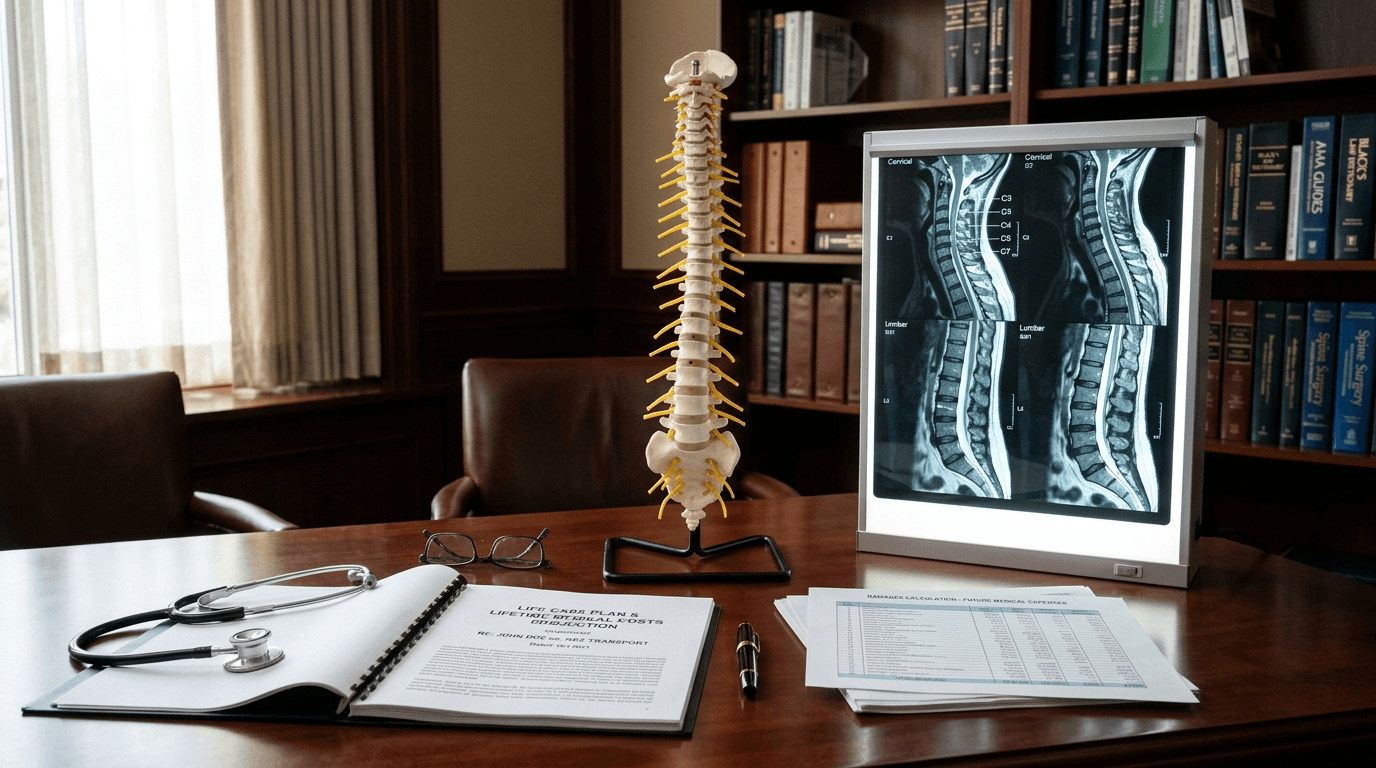
A catastrophic spinal cord injury reshapes everything — not just for the person lying in the trauma unit at Arrowhead Regional Medical Center or Loma Linda University Hospital, but for every family member who will provide care, modify their home, and absorb financial consequences that last a lifetime. If your loved one suffered a spinal cord injury in a collision on the I-15, Highway 395, or any High Desert roadway, the at-fault driver's standard auto insurance policy is almost certainly insufficient to cover even a fraction of the lifetime costs ahead. Understanding how California law allows you to pursue multi-million dollar recovery across multiple sources of liability is not optional — it is the difference between lifetime care and lifetime financial devastation.
Complete vs. incomplete spinal cord injuries — and why the distinction shapes your claim
The spinal cord runs from the base of the brain through the spinal canal, carrying motor and sensory signals between the brain and the body. When the cord is damaged by traumatic force — compression fractures, burst vertebrae, or penetrating injuries from vehicle wreckage — the resulting disability depends on where the damage occurs and whether the cord is completely or incompletely severed.
Cervical injuries (C1-C7) affect the highest segment of the spinal cord. Damage at C1-C4 can result in quadriplegia (paralysis of all four limbs) and may eliminate the ability to breathe independently, requiring lifetime mechanical ventilation. Damage at C5-C7 typically preserves some upper extremity function but results in paralysis of the hands, trunk, and lower body.
Thoracic injuries (T1-T12) generally result in paraplegia — full function of the arms and hands but paralysis of the trunk and lower extremities. The patient uses a wheelchair for mobility and may retain varying degrees of trunk stability depending on the level of injury.
Complete vs. incomplete describes whether any nerve signals pass through the injury site. A complete spinal cord injury means no motor or sensory function below the level of injury — the paralysis is total and permanent. An incomplete injury preserves some pathways, allowing partial sensation or movement below the injury. Incomplete injuries have better prognosis for partial recovery through rehabilitation, but both classifications involve lifetime disability and medical care needs.
The level and completeness of the injury directly determine lifetime care cost projections — the single largest component of the settlement demand.
Why standard auto insurance is catastrophically insufficient
California law requires drivers to carry minimum liability insurance of $15,000 per person / $30,000 per accident. Even drivers who voluntarily carry $100,000 or $250,000 policies carry coverage that represents a tiny fraction of the actual lifetime cost of spinal cord paralysis.
The National Spinal Cord Injury Statistical Center (NSCISC) (opens in new tab) publishes annual data on lifetime care costs. For a 25-year-old who sustains a high cervical (C1-C4) complete injury, estimated lifetime costs exceed $10 million in direct medical and personal care expenses alone — excluding lost wages and lost earning capacity. For a 25-year-old with paraplegia, lifetime costs exceed $3 million.
These figures include attendant care (often 24/7 for cervical injuries), recurring hospitalizations for pressure ulcers, urinary tract infections, respiratory complications, and autonomic dysreflexia, wheelchair and seating system replacements every 3-5 years, and medications that manage spasticity, pain, and bowel/bladder function.
A $15,000 insurance policy against a $5 million lifetime care need is not a mismatch — it is a financial catastrophe. The legal strategy for catastrophic spinal cord cases must identify and pursue every available source of recovery beyond the at-fault driver's personal auto policy.
Product liability and government entity claims in catastrophic spine cases
Catastrophic spinal cord injuries often involve collision dynamics where multiple parties share liability — and each party may carry independent insurance coverage that can be stacked to approach adequate compensation.
Commercial vehicle policies: If a truck, bus, or commercial vehicle caused the crash, the motor carrier's insurance policy provides $750,000 to $5,000,000 in coverage depending on cargo classification and FMCSA requirements. Pursuing the commercial carrier, the driver, and potentially the shipper or vehicle maintenance company creates multiple coverage pools.
Vehicle defect and product liability: Roof crush in rollover accidents is a leading cause of catastrophic spinal cord injury. If the vehicle's roof structure failed under forces it should have withstood — violating FMVSS 216 roof crush resistance standards — the vehicle manufacturer, roof component supplier, and design engineers may all share liability. Seatbelt failure, airbag malfunction, and defective seat-back collapse are additional product liability theories that open access to manufacturer insurance policies worth tens or hundreds of millions of dollars.
Government entity liability: If a dangerous roadway condition contributed to the crash — inadequate guardrails on the Cajon Pass, missing signage on Highway 395, defective road design on I-15 interchange ramps — Caltrans or San Bernardino County may share liability under the California Government Tort Claims Act. Government entity claims require a written notice of claim within six months (Government Code § 911.2), making early legal intervention critical.
Umbrella and excess policies: The at-fault driver may carry a personal umbrella policy of $1 million to $5 million above their auto coverage. Identifying umbrella coverage requires formal discovery or early demand correspondence that triggers disclosure obligations.
The Life Care Plan: calculating your future
A Life Care Plan is a comprehensive, medically substantiated document that projects every category of future care cost over the patient's remaining life expectancy. It is prepared by a Certified Life Care Planner — typically a nurse or rehabilitation professional with specialized training — in coordination with treating physicians, rehabilitation specialists, and vocational economists.
The Life Care Plan includes:
Future medical care: Recurring hospitalizations, specialist visits (urology, pulmonology, physiatry), medications, imaging, and preventive care for secondary complications. Attendant care: Hours of daily personal care assistance (bathing, dressing, transfers, bowel and bladder programs) multiplied by hourly rates over remaining life expectancy. For high cervical injuries, this alone can exceed $2 million over a lifetime. Durable medical equipment: Power wheelchairs ($25,000-$70,000 each, replaced every 3-5 years), hospital beds, standing frames, pressure-relief cushions, vehicle transfer systems. Home modification: Wheelchair-accessible renovation including widened doorways, roll-in showers, elevator or ramp installation, accessible kitchen modifications — typically $100,000 to $300,000 for a comprehensive adaptation. Transportation: Wheelchair-accessible van with hand controls and power ramp ($60,000-$90,000, replaced every 5-7 years). Vocational economic analysis: A vocational expert calculates lost earning capacity — the difference between what the victim would have earned over their working life without the injury and what they can earn (if anything) with the disability.
The Life Care Plan and vocational analysis together produce a total future damages figure that serves as the foundation of the settlement demand or trial presentation. In Arrowhead Regional Medical Center and Loma Linda University rehabilitation units, these plans are developed in coordination with the patient's rehabilitation team to ensure accuracy.
Pursuing multi-million dollar recovery in San Bernardino County
Catastrophic spinal cord injury cases almost always exceed the at-fault driver's policy limits. When the policy limits are tendered (offered in full), the legal analysis shifts to identifying additional defendants and coverage sources that can fund adequate lifetime care.
Insurance companies that fail to tender policy limits promptly in a clear-liability catastrophic injury case expose themselves to bad faith liability under California law. An insurer that lowballs or delays on a quadriplegia claim where liability is clear risks an excess judgment — a verdict above policy limits that the insurer itself must pay. This bad faith exposure is a powerful lever in catastrophic case negotiations.
A Victorville personal injury lawyer experienced in catastrophic injury litigation understands how to identify all available coverage, retain qualified Life Care Planners and vocational economists, and present lifetime care cost projections in a format that makes the true scope of the injury undeniable. Understanding average personal injury settlement values in California provides context — but catastrophic spinal cord cases operate in an entirely different tier, often exceeding $5 million when multiple defendants and coverage sources are properly pursued. Cases involving commercial trucks add FMCSA-mandated coverage that can reach the levels necessary to fund lifetime paralysis care.
This resource is independent and free to use. It is not a law firm and does not provide legal advice. For advice about your specific situation, speak with a qualified attorney.