What Happens If the At-Fault Driver Is Uninsured in California?
What to do when the at-fault driver has no insurance in California: how UM/UIM coverage works, Proposition 103 premium protection, hit-and-run rules, and High Desert scenarios.
- By
- Victorville PI Resource Editorial Team
- Published
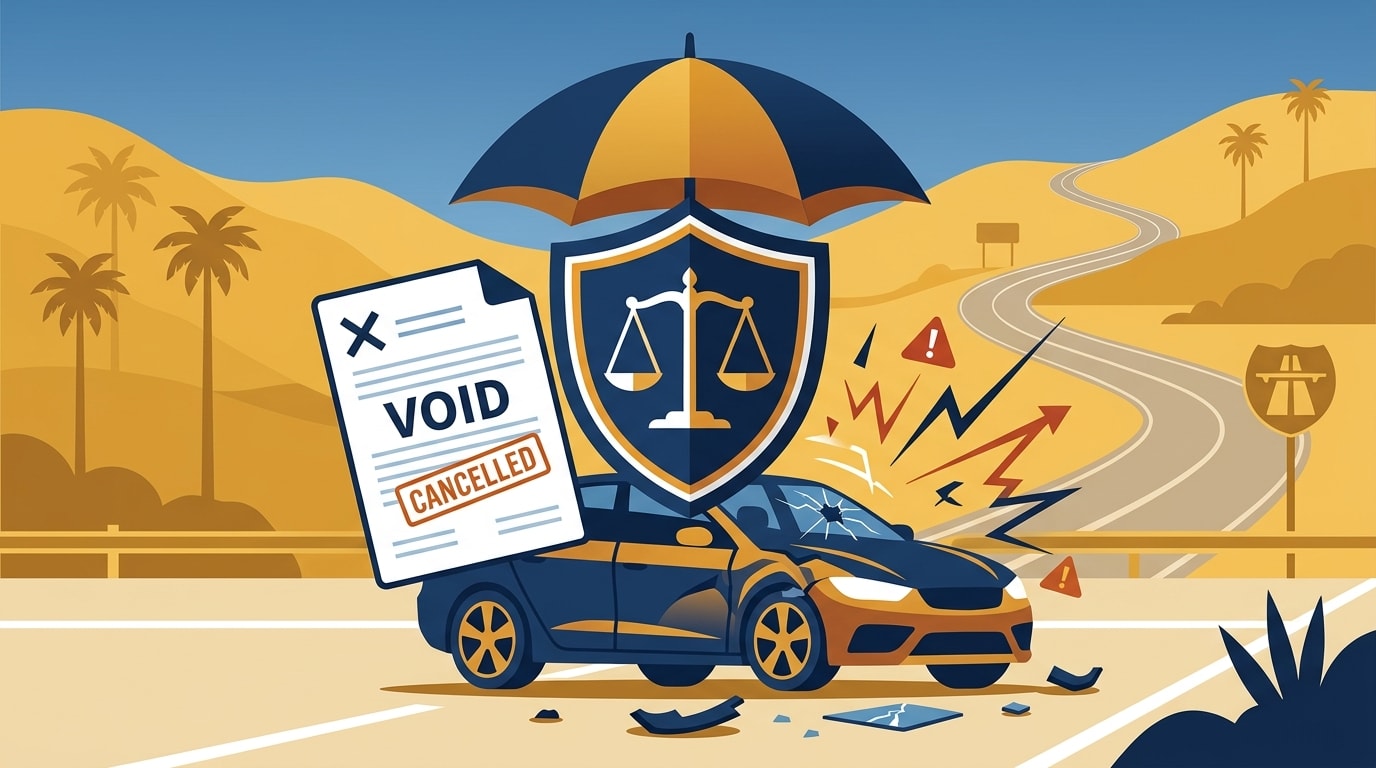
You have been hit by another driver. The police arrive. And then you learn the worst possible news: the other driver has no insurance — or they fled the scene entirely. The immediate assumption most victims make is devastating and wrong: "I have to pay for everything myself." You do not. California law provides multiple pathways to compensation even when the at-fault driver carries no insurance, and understanding these pathways can mean the difference between financial ruin and a full recovery. This guide is general legal information, not legal advice.
You are not stuck paying for everything — how UM/UIM coverage works
Uninsured Motorist (UM) coverage is a provision on your own auto insurance policy that pays for your injuries when the at-fault driver has no liability insurance at all. Underinsured Motorist (UIM) coverage kicks in when the at-fault driver has insurance, but their policy limits are too low to cover your full damages.
Here is the critical fact that most people do not realize: when you file a UM/UIM claim, you are filing against your own insurance company — not the other driver's. Your insurer steps into the shoes of the at-fault driver's missing coverage and compensates you for your injuries, lost wages, and pain and suffering, up to the limits of your UM/UIM policy.
This distinction matters because it changes the entire dynamic of the claim. You are no longer trying to collect from someone who has nothing. You are negotiating with a solvent, regulated insurance company that has a contractual obligation to pay valid claims. For context on how these claims are valued, our guide on how much a car accident settlement is worth in California explains the formula that applies to UM/UIM claims just as it does to standard liability claims.
What California law requires your insurance company to offer
California takes uninsured motorist coverage seriously because of the scale of the problem. An estimated 15 to 16 percent of California drivers are uninsured — one of the highest rates in the nation. In the High Desert, where many residents face economic pressures and long commutes, the rate may be even higher.
Under California Insurance Code § 11580.2 (opens in new tab), every auto insurance company operating in California is required to offer UM/UIM coverage to every policyholder. If you want to reject UM/UIM coverage, you must sign a written waiver — the insurer cannot simply leave it off your policy without your explicit, documented refusal.
This means that unless you specifically signed a waiver declining UM/UIM coverage, your policy almost certainly includes it. Many policyholders have UM/UIM coverage and do not even know it. The first step after being hit by an uninsured driver is to review your own policy declarations page — the answer may already be there.
How hit-and-run accidents are treated under uninsured motorist rules
In the High Desert, hit-and-run accidents are a persistent problem — particularly on high-speed corridors like Interstate 15 and Highway 395, where drivers flee the scene and are never identified. California law addresses this directly: an unidentified hit-and-run driver is legally treated as an uninsured motorist, which means your UM coverage applies.
However, there are specific requirements you must meet to qualify for UM coverage in a hit-and-run situation. You must file a police report within 24 hours of the accident. There generally must have been physical contact between your vehicle and the fleeing vehicle — this requirement exists to prevent fraudulent claims. And you must notify your own insurance company promptly.
If the hit-and-run driver is eventually identified but turns out to have no insurance, the physical contact requirement is waived — the standard UM claim process applies. Understanding whether to accept the first settlement offer is just as important in UM claims as in standard claims, because your own insurer's first offer may be equally aggressive in undervaluing your case.
Why Proposition 103 protects you from premium increases
One of the most common fears that prevents victims from filing UM claims is the belief that their own insurance company will raise their premiums in retaliation. This fear is understandable — but in California, it is addressed by law.
Proposition 103, passed by California voters, restricts insurers from raising your rates, canceling your policy, or refusing to renew your coverage solely because you filed a not-at-fault claim. A UM claim arising from an accident caused by an uninsured driver is, by definition, a not-at-fault claim. Your insurer cannot legally penalize you for using the coverage you paid for.
If your insurer does attempt to raise your rates after a not-at-fault UM claim, you have the right to challenge the increase and file a complaint with the California Department of Insurance. The law is clear: you paid for UM coverage, you were not at fault, and your insurer must honor the policy without financial retaliation.
Uninsured driver scenarios on the I-15 corridor and High Desert roads
The High Desert's geography creates specific conditions where uninsured driver accidents are particularly common and particularly dangerous. The I-15 corridor between Victorville and Barstow carries heavy commercial and passenger traffic at high speeds. Drivers passing through — including out-of-state motorists and long-haul travelers — may carry minimal or no insurance.
Bear Valley Road, Palmdale Road, and Highway 18 see frequent collisions at intersections where high-speed arterial traffic meets local neighborhood traffic. When the at-fault driver in these collisions is uninsured or flees the scene, the victim is left facing serious injuries with no obvious path to compensation — unless they understand that their own UM/UIM policy is the answer.
For comprehensive coverage of California car accident law and the full claims process, our guide on how California car accident claims are evaluated and pursued explains the complete legal framework that applies whether the at-fault driver has insurance or not.
This resource is independent and free to use. It is not a law firm and does not provide legal advice. For advice about your specific situation, speak with a qualified attorney.