Internal Injuries from Car Accident Settlement in California
California internal injury settlement guide: ruptured spleen, liver lacerations, internal bleeding, ICU hospitalization costs, and long-term complications that adjusters ignore.
- By
- Victorville PI Resource Editorial Team
- Published
Internal injuries from high-speed collisions on the I-15 and Highway 395 are among the most lethal — and the most undervalued — injuries in California personal injury law. A crash victim walks out of the ER with a "cleared" discharge summary, drives home, and collapses six hours later from internal hemorrhage. The organs injured in a blunt abdominal trauma do not always announce themselves immediately. When the insurance adjuster eventually calls and says your loved one has "fully healed" because the bleeding stopped, they are deliberately ignoring a medical reality that will affect the victim for the rest of their life.
How internal organs are injured in high-speed collisions
Internal organ injuries in motor vehicle crashes result from two distinct mechanisms, and understanding both is critical to valuing the claim correctly.
Blunt compressive force occurs when the abdomen is crushed between the seatbelt and the spine during rapid deceleration. The lap belt distributes enormous force across the lower abdomen, compressing soft organs — the spleen, liver, kidneys, and intestines — against the rigid vertebral column behind them. This mechanism produces splenic ruptures, liver lacerations, and mesenteric tears that cause internal bleeding into the abdominal cavity.
Deceleration shear force occurs when the body stops but the internal organs continue moving at collision speed, tearing the ligamentous attachments that anchor organs to the abdominal wall. The liver tears at its attachment points along the hepatic veins. The spleen tears at the splenic hilum. The kidneys avulse from the renal pedicle. These tears are not always catastrophic at the moment of injury — they can bleed slowly for hours before the blood loss becomes life-threatening.
Seatbelt syndrome is the clinical term for the complex of injuries produced specifically by lap belt compression. It includes abdominal wall bruising (the classic seatbelt sign), hollow organ injuries (bowel perforations and mesenteric lacerations), solid organ injuries, and lumbar vertebral fractures (Chance fractures). When the treating emergency physician documents a seatbelt sign on the abdomen, the probability of significant internal organ injury rises dramatically — and every hour of delayed diagnosis increases the risk of fatal hemorrhage.
Why victims leave the ER and collapse hours later
The most dangerous characteristic of internal organ injuries is their deceptive initial presentation. Adrenaline and vasoconstriction temporarily maintain blood pressure even as internal bleeding accumulates. A crash victim who feels "sore but okay" at the scene may have a slow splenic laceration filling their abdominal cavity with blood at a rate too slow to trigger immediate shock symptoms.
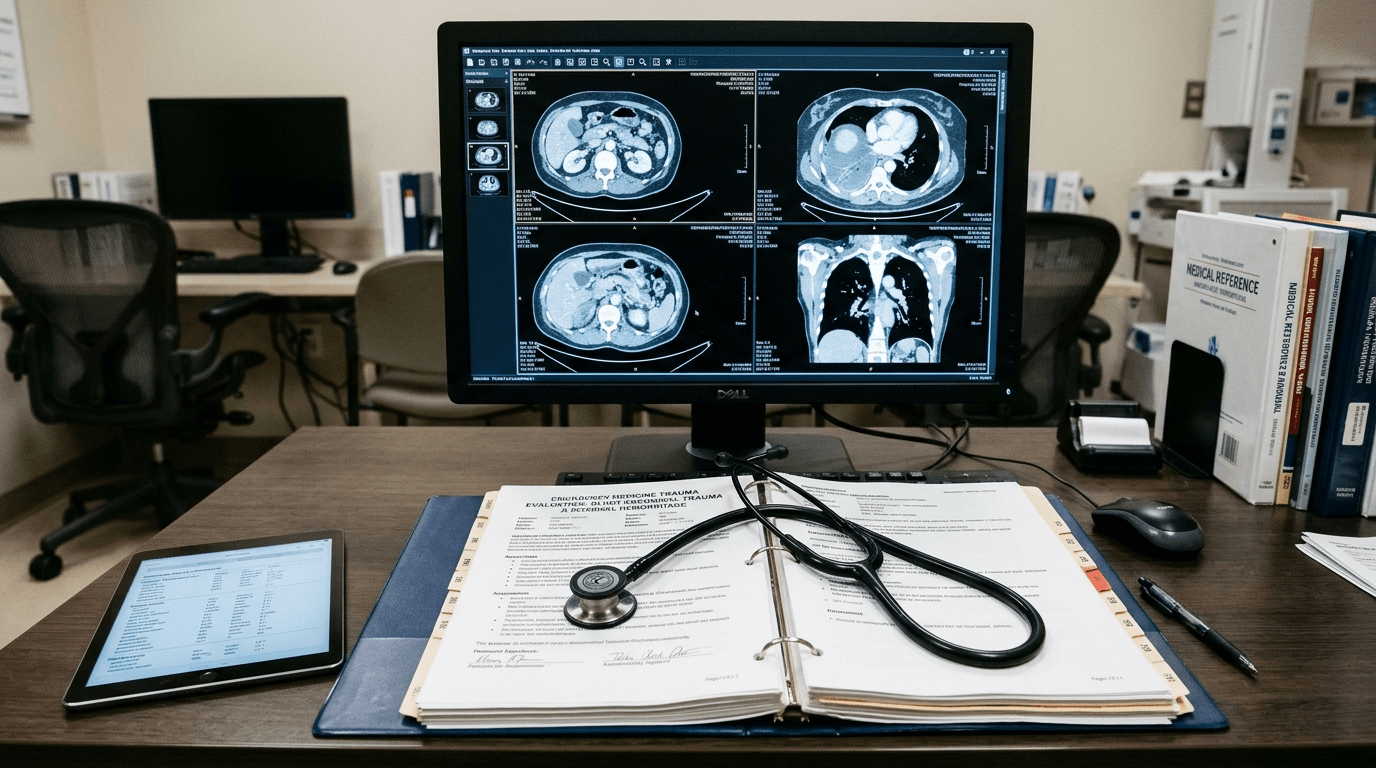
Emergency room physicians at Desert Valley Hospital and Victor Valley Global Medical Center use CT imaging of the abdomen and pelvis to identify organ injuries. Low-grade splenic lacerations (Grade I–II on the American Association for the Surgery of Trauma organ injury scale) are frequently managed with watchful waiting rather than immediate surgery — the patient is admitted, monitored, and discharged within 24-48 hours if bleeding appears to stabilize. But a "stable" low-grade laceration can convert to catastrophic hemorrhage days later if the patient resumes normal activity.
Crash victims who are not admitted — or who leave against medical advice because they "feel fine" — face the most dangerous scenario. They return home, the adrenaline wears off, and the bleeding accelerates. By the time they call 911, they are in hemorrhagic shock. Air ambulance transport to Arrowhead Regional Medical Center in Colton — the designated trauma center for San Bernardino County — may be the only option if ground transport cannot reach them in time.
Emergency surgery costs and ICU hospitalization at High Desert trauma centers
When internal bleeding requires surgical intervention, the medical costs escalate immediately into the hundreds of thousands of dollars.
Emergency exploratory laparotomy — abdominal surgery performed to identify and control bleeding — carries hospital facility fees of $80,000 to $150,000 before physician fees. Splenectomy (surgical removal of the ruptured spleen) adds surgeon, anesthesiologist, and operating room costs bringing total surgical billing to $120,000 to $200,000. Liver lacerations requiring hepatic resection (removal of damaged liver tissue) are among the most complex abdominal surgeries in trauma care, with total costs routinely exceeding $300,000 to $500,000 when ICU care is factored in.
ICU hospitalization at Arrowhead Regional Medical Center or Providence St. Mary Medical Center runs $5,000 to $15,000 per day. A crash victim requiring ten days of ICU care followed by two weeks of step-down care generates hospital bills of $150,000 to $400,000 before physician, radiology, laboratory, or rehabilitation costs. These are the special damages — the actual dollars spent on medical care — that form the baseline of the settlement calculation.
The "fully healed" defense — and why it is medically false
Insurance adjusters frequently argue that internal injury victims have "fully healed" once the acute bleeding is controlled and the patient is discharged from the hospital. This argument ignores the long-term medical consequences that are established and documented in surgical and trauma medicine.
Lifelong immune vulnerability after splenectomy: The spleen filters blood-borne bacteria and produces immune cells that target encapsulated organisms — Streptococcus pneumoniae, Haemophilus influenzae, and Neisseria meningitidis. After splenectomy, clinical research documented by the National Institutes of Health (opens in new tab) confirms a permanent overwhelming post-splenectomy infection (OPSI) risk — a condition where a bacterial infection that a healthy person would fight off in days can progress to fatal septic shock within hours in an asplenic patient. This is a permanent, lifelong immunological disability.
Abdominal surgical adhesions: Every abdominal surgery produces scar tissue that adheres between bowel loops, between the bowel and the abdominal wall, and between organs. These adhesions cause chronic abdominal pain, bloating, and nausea. In 15 to 35 percent of patients with prior abdominal surgery, adhesions eventually cause small bowel obstruction — a life-threatening emergency requiring repeat surgery.
Chronic digestive dysfunction: Bowel perforations that required resection (removal of damaged intestinal segments) permanently alter digestive capacity. Patients experience chronic diarrhea, malabsorption, nutritional deficiencies, and dietary restrictions for life.
Permanent physical work restrictions: The treating surgeon's permanent restrictions — no heavy lifting, no overhead work, no repetitive bending or twisting — represent lost earning capacity for High Desert manual laborers, construction workers, and logistics employees whose jobs require physical capacity the surgery eliminated.
What internal injury settlements are worth in California
Internal injury cases with emergency surgery produce special damages of $150,000 to $500,000+ in most cases. Under California Civil Code § 3333 (opens in new tab), crash victims are entitled to recover all economic and non-economic damages proximately caused by the collision, with attorneys and adjusters applying a general damages multiplier to the special damages base — typically 3x to 5x for cases with life-threatening surgical intervention and documented permanent complications.
A case with $200,000 in surgical and ICU medical specials, permanent splenectomy with documented OPSS risk, and work restrictions that eliminate the victim's ability to perform their occupation generates a total damages claim in the $600,000 to $1,000,000 range. Cases involving liver resection with permanent hepatic function impairment or bowel resection with documented digestive disability push higher.
Understanding who pays medical bills while your case is pending is urgent in internal injury cases because the surgical costs arrive within 30 days and the case may take 18 to 24 months to resolve. A Victorville car accident lawyer can coordinate medical liens with trauma surgeons and hospitalists so treatment is not delayed by financial barriers. Reviewing average California personal injury settlement values reveals why internal injury cases — with their combination of catastrophic medical costs and permanent long-term consequences — consistently command some of the highest recoveries in San Bernardino County courts.
This resource is independent and free to use. It is not a law firm and does not provide legal advice. For advice about your specific situation, speak with a qualified attorney.