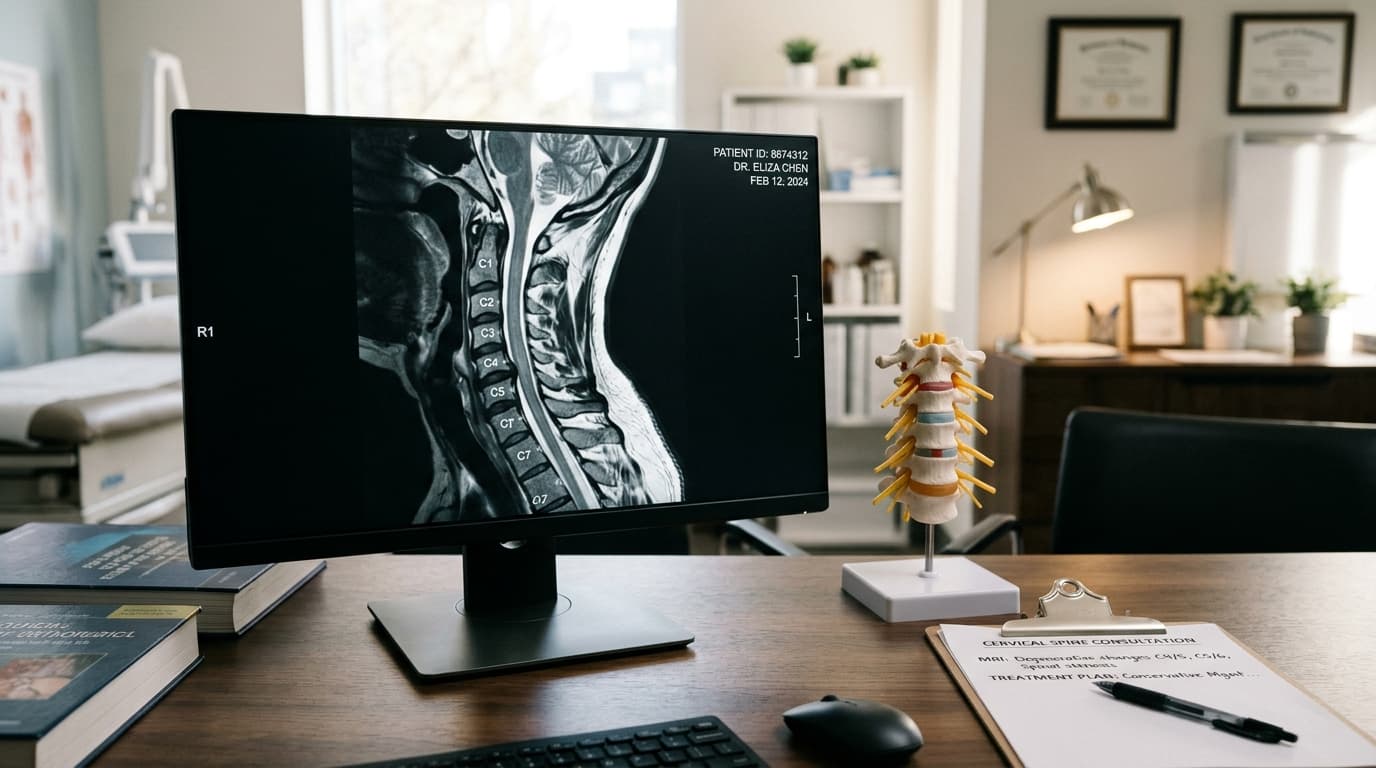
Herniated Disc Car Accident Settlement in California
California herniated disc settlement guide: defeating the degenerative disc defense, the Eggshell Plaintiff Doctrine (CACI 3927), treatment hierarchy, and six-figure settlement values.
- By
- Victorville PI Resource Editorial Team
- Published
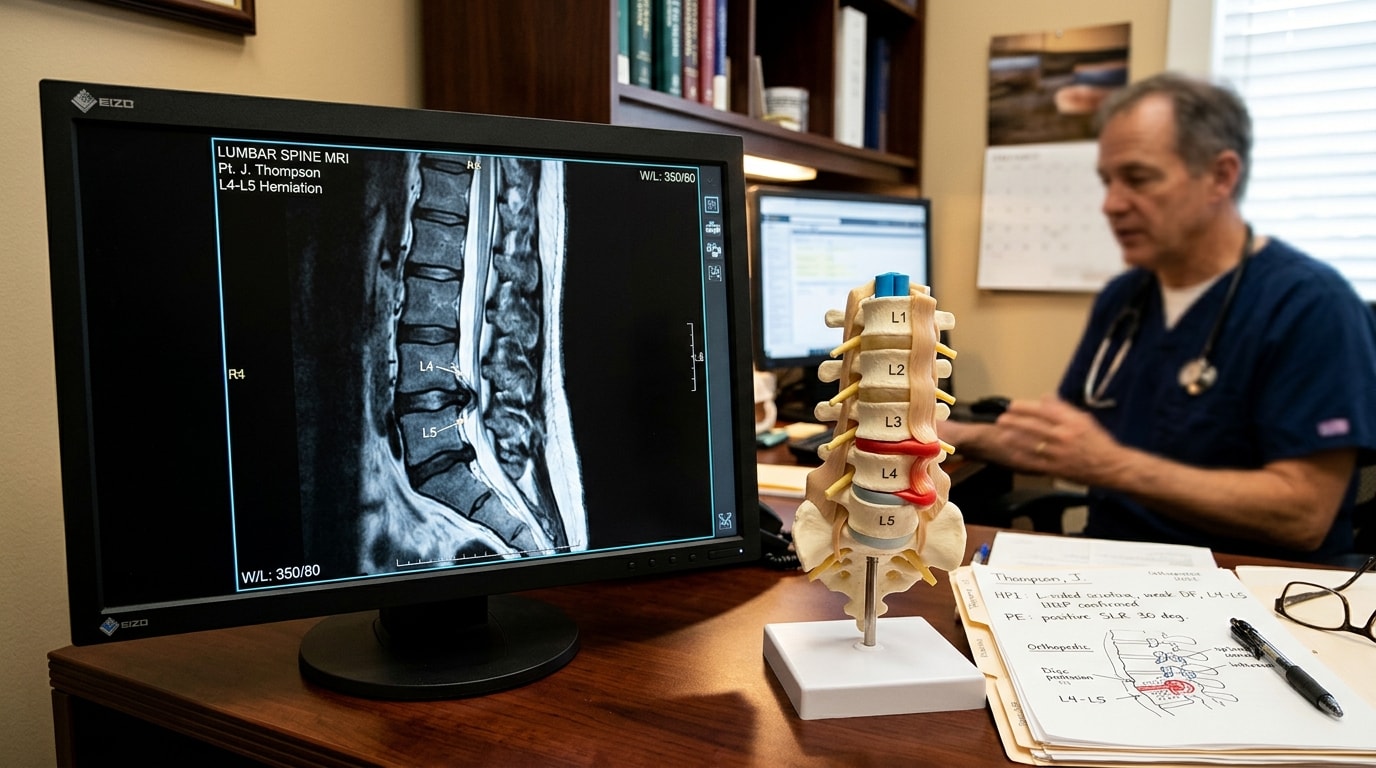
The MRI report confirmed what you already felt: a herniated disc at L4-L5, L5-S1, or C5-C6. The shooting nerve pain down your leg or arm is not going away. You expected the at-fault driver's insurance to take this seriously — instead, the adjuster pulled out the defense they use on nearly every disc injury claim in California: "This is degenerative disc disease. It was there before the crash." That argument is designed to make you accept a fraction of what your claim is worth. California law has a specific, powerful answer to it.
What a herniated disc actually is — and why your MRI report matters
Your spine is a column of vertebrae separated by intervertebral discs — gel-filled cushions that absorb shock and allow flexibility. Each disc has a tough outer layer called the annulus fibrosus and a soft inner core called the nucleus pulposus. In a high-force collision, the compression and shear forces on the spine can cause the annulus to tear, allowing the nucleus to push outward — a herniation.
The clinical severity depends on the degree of displacement:
A bulging disc extends beyond its normal boundary but the annulus remains intact. A herniated disc involves a tear in the annulus with nucleus material pushing through. An extruded disc means the nucleus material has broken completely through the annulus and may be compressing the spinal cord or nerve roots. A sequestered disc means a fragment has separated entirely and is floating in the spinal canal.
The location determines the symptoms. A herniation at L4-L5 or L5-S1 in the lumbar spine compresses the sciatic nerve, producing shooting pain, numbness, and tingling radiating from the lower back down through the buttock and leg — sciatica. A herniation at C5-C6 or C6-C7 in the cervical spine compresses cervical nerve roots, producing radiating pain, weakness, and numbness down the shoulder, arm, and into the fingers — cervical radiculopathy.
Your MRI report is the single most important document in your claim. It provides objective, visualizable proof that a structural injury exists. Without it, the adjuster treats your pain as subjective and unverifiable.
The "degenerative disc disease" defense — and how California law destroys it
The insurance industry's most effective defense against disc injury claims is predictable: the adjuster hires an Independent Medical Examination (IME) doctor — paid by the insurance company — who reviews your MRI and writes a report stating that your disc herniation is "consistent with age-related degenerative changes" rather than acute trauma from the collision.
This defense exploits a medical reality: virtually every adult over 30 has some degree of disc degeneration visible on MRI, whether or not they have any symptoms. The adjuster's argument is simple — the degeneration was already there, so the crash did not cause it.
California law rejects this argument entirely.
CACI Jury Instruction No. 3927 — Aggravation of Preexisting Condition instructs California juries that a defendant takes the plaintiff as they find them. This is the Eggshell Plaintiff Doctrine. If the plaintiff had a pre-existing degenerative disc that was completely asymptomatic before the crash, and the crash caused that disc to herniate or become symptomatic, the defendant is liable for all resulting damages — the full cost of medical treatment, the full extent of pain and suffering, and the full impact on the plaintiff's life.
The legal standard is not whether the disc was "perfect" before the crash. The standard is whether the plaintiff was functioning without pain before the crash and is now disabled by pain after the crash. If the crash caused an asymptomatic condition to become symptomatic, the defendant pays for all of it.
Defeating the degenerative disc defense requires before-and-after medical records showing that you had no spine-related complaints, no chiropractic visits, and no pain medication prescriptions before the collision date. Your primary care physician's records from the 12 to 24 months preceding the crash are the most powerful evidence against this defense.
The treatment hierarchy: conservative care to surgery
Herniated disc treatment follows a medically recognized escalation protocol. Insurance adjusters know this protocol — and they know that their financial exposure increases dramatically at each step.
Conservative care (weeks 1–12): Physical therapy two to three times per week to strengthen core musculature, improve spinal stability, and reduce nerve compression through traction and decompression techniques. Chiropractic manipulation may provide symptomatic relief. Anti-inflammatory medications and muscle relaxants manage acute pain.
Epidural steroid injections (ESIs) (weeks 8–16): When conservative care fails to resolve radiculopathy, a pain management specialist injects corticosteroids directly into the epidural space surrounding the compressed nerve root. Most treatment protocols allow up to three injections over a 12-month period. Each injection costs $2,000 to $5,000 and generates medical records documenting that conservative care was insufficient — a critical escalation in claim value.
Surgical intervention (when conservative and injection therapy fail): The three most common surgical procedures for crash-related disc herniations are microdiscectomy (removing the herniated portion of the disc to relieve nerve compression), anterior cervical discectomy and fusion (ACDF) (removing the damaged disc and fusing adjacent vertebrae with a titanium plate), and artificial disc replacement (replacing the damaged disc with a prosthetic device that preserves motion). Each procedure costs $50,000 to $150,000 and permanently transforms the claim into a surgical case.
Insurance companies want you to stop at physical therapy. Every escalation beyond PT increases their exposure exponentially.
Why surgical herniated disc cases command six-figure settlements
A herniated disc case that progresses to surgery crosses a threshold that fundamentally changes the settlement calculus. Surgical cases produce permanent impairment — the plaintiff will never return to their pre-crash spinal condition. An ACDF eliminates motion at the fused vertebral level permanently. A microdiscectomy removes disc material that does not regenerate. Artificial disc replacement installs a mechanical device that has a finite lifespan and may require revision surgery decades later.
Permanent impairment is assessed through an orthopedic independent medical examination that assigns a whole-person impairment rating under the AMA Guides. That percentage directly influences the general damages multiplier — a 10 percent whole-person impairment rating on a case with $80,000 in medical specials (surgery, PT, injections, imaging) generates general damages claims of 4x to 6x, pushing total settlement demands into the $300,000 to $500,000 range.
In San Bernardino County, herniated disc cases with ACDF or fusion surgery routinely settle between $150,000 and $500,000 (opens in new tab) depending on the number of levels fused, the age of the plaintiff, and the strength of the causation evidence. Multi-level fusions with documented permanent work restrictions can exceed $750,000.
Protecting your herniated disc claim
The foundation of a strong herniated disc claim is unbroken medical treatment from the date of the crash through maximum medical improvement. Every gap in treatment gives the adjuster ammunition to argue that your condition is not as severe as you claim.
If you cannot afford out-of-pocket medical costs while waiting for your case to resolve, medical liens allow you to receive treatment — including surgery from premier Inland Empire orthopedic and neurosurgical specialists — without paying upfront. The surgeon's lien is paid from the final settlement, and understanding who pays medical bills while waiting for a settlement is essential to avoiding treatment gaps driven by financial pressure.
A Victorville car accident lawyer experienced in spine injury cases knows how to counter the degenerative disc defense with CACI 3927, coordinate surgical liens with qualified surgeons, and document permanent impairment in a format that maximizes your recovery. The difference between a $30,000 offer on an undocumented disc bulge and a $300,000 settlement on a surgically documented herniation is not luck — it is the medical and legal documentation strategy applied from day one. Understanding realistic California car accident settlement values helps you evaluate whether any offer reflects the true severity of your injury.
This resource is independent and free to use. It is not a law firm and does not provide legal advice. For advice about your specific situation, speak with a qualified attorney.