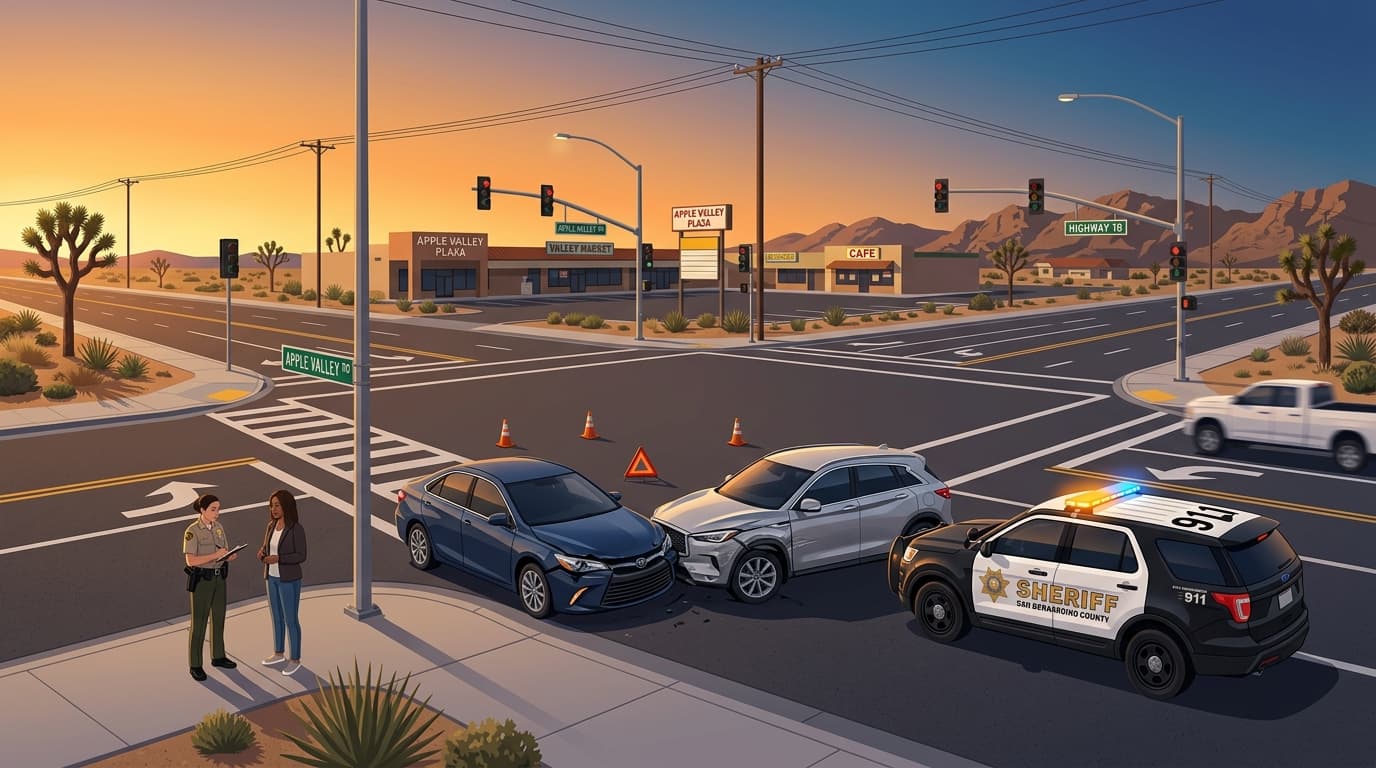
What to Do After a Car Accident in Phelan, CA
Phelan car accident guide: CHP vs. SBCSD jurisdiction, Phelan Road and Highway 138 crash patterns, air ambulance medevac, and how to protect your injury claim.
- By
- Victorville PI Resource Editorial Team
- Published
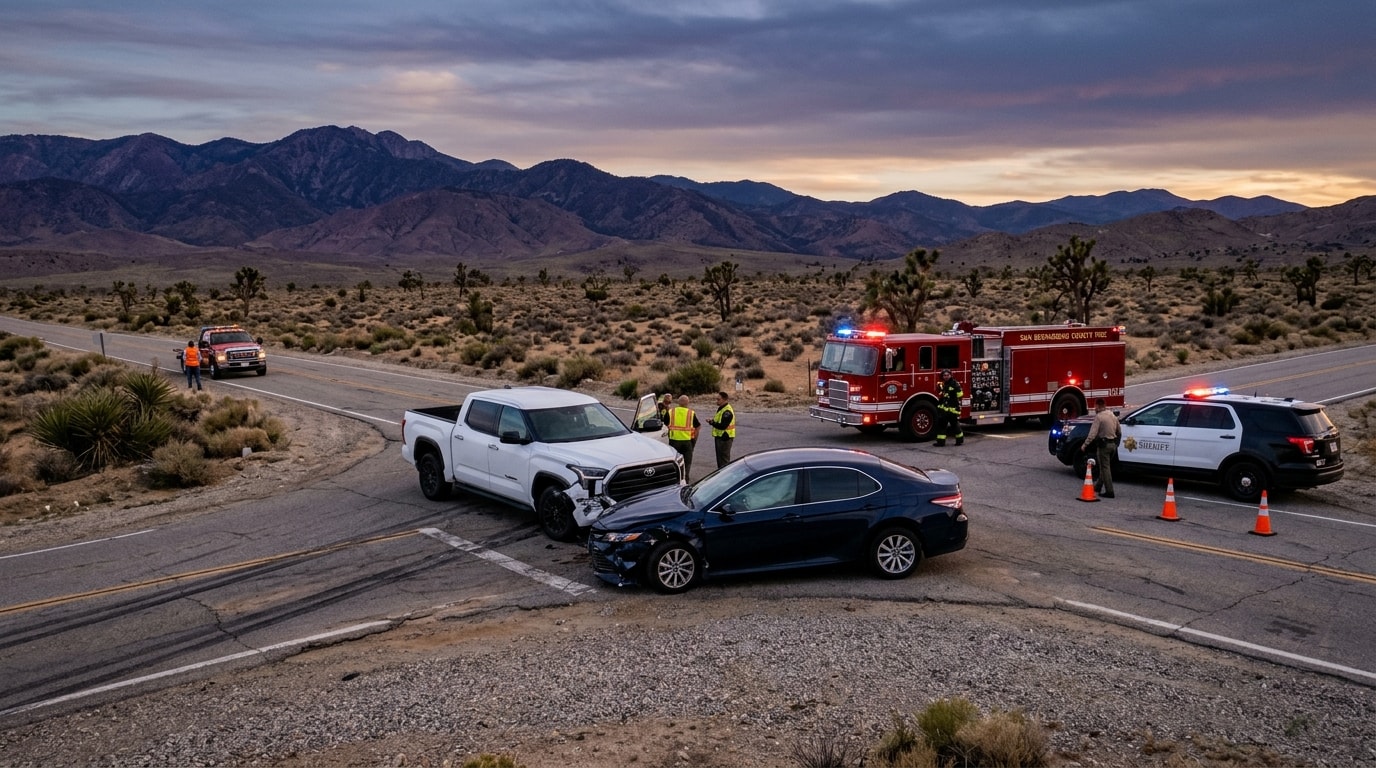
Phelan sits in one of the most isolated stretches of the western High Desert. The two-lane rural highways that connect this unincorporated community — Phelan Road, Sheep Creek Road, and Highway 138 — have zero physical center barriers, minimal lighting, and speed limits that push passenger vehicles into head-on collision trajectories with oncoming traffic. If you were just injured in a crash on one of these roads, the steps you take in the next 48 hours will shape everything that follows.
Why Phelan car accidents are uniquely dangerous
The roads through Phelan were built decades ago to serve sparse rural traffic. Today they carry commuter volumes that far exceed their design capacity, and the infrastructure has not kept pace. Phelan Road runs east-west through the community's core with narrow lanes, blind hills, and uncontrolled intersections where side streets feed directly into 55 mph traffic.
Sheep Creek Road intersects Phelan Road at an angle that forces drivers into wide turning arcs, creating T-bone collision risks at peak commute hours. Drivers heading south toward the Cajon Pass routinely misjudge closing speeds on these undivided stretches.
Highway 138 transitions through Phelan as it connects the Cajon Pass to the western Mojave. This corridor funnels high-speed traffic through a mix of residential driveways, unpaved cross-streets, and commercial entrances with almost no deceleration lanes. Head-on collisions on these undivided two-lane highways generate combined impact forces exceeding 100 mph — the kind of energy that produces catastrophic injuries even in modern vehicles.
Which agency investigates your Phelan crash
Phelan is an unincorporated community in San Bernardino County, which means there is no municipal police department. Two agencies share jurisdiction, and knowing which one investigated your crash determines where you obtain the collision report.
The California Highway Patrol (CHP) Victorville Area Office (opens in new tab) at 14210 Amargosa Road handles all collisions that occur on state highways (Highway 138) and county roads outside of residential subdivisions. CHP officers generate a CHP 555 Traffic Collision Report that contains the investigating officer's fault determination, witness statements, road and weather conditions, and a scene diagram. This report is the single most important document in your injury claim.
The San Bernardino County Sheriff's Department (SBCSD) Phelan Substation responds to collisions on local residential streets and private roads within the community. If SBCSD responded to your crash, request the report through the San Bernardino County Sheriff's Records Division.
Understanding which agency holds your report prevents weeks of delay. If you are unsure, call the CHP Victorville Area Office first — they handle the majority of serious injury collisions in the Phelan corridor.
Emergency response and trauma transport challenges
Emergency medical response in Phelan is dispatched from San Bernardino County Fire Station 10, which serves the entire Phelan and Pinon Hills area. Because the station covers dozens of square miles of sparsely populated desert, dispatch-to-scene times routinely exceed 15 to 25 minutes depending on the crash location along Highway 138 or Sheep Creek Road.
For critical trauma patients, ground ambulance transport faces a second challenge: the nearest trauma-capable hospitals are Desert Valley Hospital in Victorville (approximately 25 minutes by ground) and Arrowhead Regional Medical Center in Colton (approximately 50 minutes). When injuries involve suspected spinal cord damage, severe internal bleeding, or traumatic brain injury, paramedics call for Mercy Air or REACH Air Ambulance helicopter medevac to cut transport time and reach Level II trauma care.
The cost of air ambulance transport — often $40,000 to $80,000 per flight — is a recoverable damage in your personal injury claim. Many crash victims in rural Phelan do not realize that medevac costs are added to the total special damages that the at-fault driver's insurance must pay.
How comparative fault applies to rural head-on and T-bone collisions
California follows pure comparative negligence, which means your compensation is reduced by your percentage of fault — but never eliminated entirely. On Phelan's undivided rural highways, adjusters aggressively argue comparative fault by claiming the injured driver was traveling too fast, failed to maintain their lane, or did not react quickly enough to an oncoming vehicle that crossed the center line.
The CHP collision investigation report is critical here. CHP officers trained in Major Accident Investigation Team (MAIT) protocols reconstruct crash dynamics using skid marks, vehicle rest positions, debris fields, and electronic data recorders (EDRs) from both vehicles. This reconstruction often determines fault percentages that directly translate into settlement reductions or increases.
If the CHP report assigns 20 percent fault to you on a $200,000 claim, your recovery drops to $160,000. Fighting that 20 percent allocation — with dashcam footage, witness statements, or an independent accident reconstructionist — is fighting for $40,000 in real money.
Protecting your claim after a Phelan crash
The rural environment creates unique evidence preservation challenges. There are no traffic cameras at Phelan Road intersections, no red-light cameras, and often no commercial surveillance systems within recording range. If you are physically able, use your phone to photograph the scene, vehicle positions, road conditions, and any visible injuries before vehicles are moved.
Request a copy of the CHP 555 or SBCSD collision report within 10 days of the crash. Identify any witnesses — in rural Phelan, witnesses may be the only residents on that stretch of road, and finding them later can be extremely difficult.
If your injuries require ongoing treatment, a Victorville car accident lawyer experienced in rural High Desert claims can coordinate medical liens so you receive care immediately without paying out of pocket. The legal process for rural corridor crashes follows the same framework whether the collision occurred in Apple Valley or on Victorville's major intersections — but the evidence preservation window is shorter and the stakes of losing that evidence are higher.
This resource is independent and free to use. It is not a law firm and does not provide legal advice. For advice about your specific situation, speak with a qualified attorney.