What to Do After a Car Accident in Oak Hills, CA
Oak Hills car accident guide: I-15 Oak Hill Road interchange dangers, black ice and fog on the Cajon Pass crest, weather defense myths, and how to protect your claim.
- By
- Victorville PI Resource Editorial Team
- Published
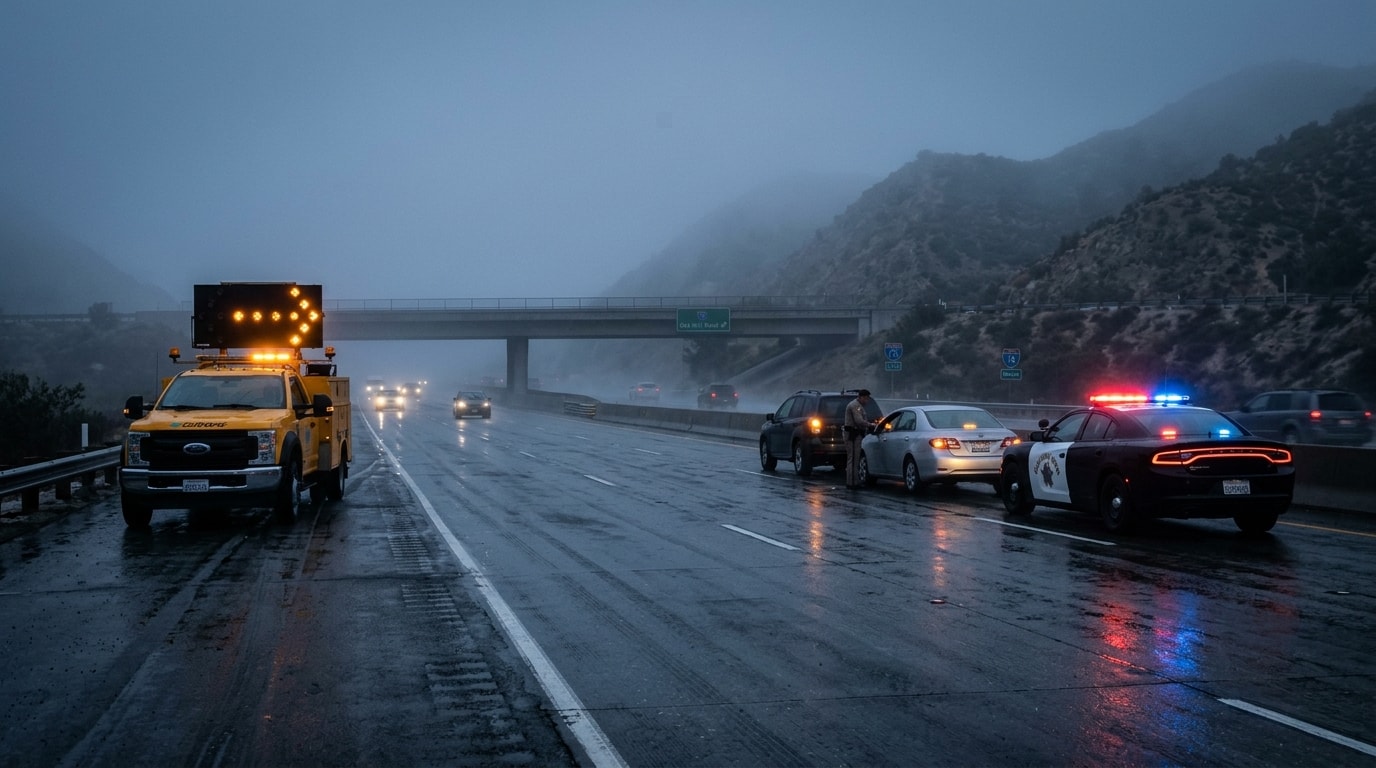
Oak Hills is an unincorporated residential and equestrian community perched on the crest of the Cajon Pass at over 3,800 feet elevation — the exact point where Interstate 15 transitions from the steep mountain grade into the flat High Desert floor. This convergence zone produces a collision pattern unlike anywhere else in San Bernardino County: freeway off-ramp traffic colliding with high-speed local commuters on roads that freeze, fog over, and get battered by crosswinds that can push a vehicle across an entire lane. If you were just injured in this area, the weather conditions and jurisdictional split create claim challenges that require immediate attention.
Why Oak Hills sits in the most dangerous convergence zone on the Cajon Pass
The I-15 Oak Hill Road interchange is the first major exit after northbound vehicles crest the Cajon Pass summit. Drivers who have been white-knuckling a steep mountain grade for 20 minutes — navigating heavy truck traffic, steep downgrades, and tight curves — suddenly arrive at an off-ramp that feeds directly into local surface streets. The deceleration from 65 mph freeway speed to the residential road network happens over a dangerously short transition zone.
Ranchero Road runs east-west through the heart of Oak Hills, carrying heavy commuter traffic between the I-15 corridor and Hesperia. During morning and evening rush hours, the intersection of Ranchero Road and Oak Hill Road processes high volumes of vehicles making left turns across oncoming traffic — a T-bone collision setup that produces severe injuries.
Mariposa Road adds another layer of complexity. This connector road carries a mix of residential, equestrian, and commercial traffic through an area where posted speed limits often exceed what the road geometry can safely support. The combination of high commuter speeds, limited sight distances at rolling hills, and the complete absence of traffic signals at key intersections creates a crash environment where reaction time is measured in fractions of a second.
Microclimate hazards: freezing fog, black ice, and severe crosswinds
Oak Hills experiences weather conditions that most High Desert residents never encounter at lower elevations. At 3,800 feet on the Cajon Pass crest, freezing fog forms rapidly during winter months, reducing visibility to less than 100 feet and depositing a thin layer of ice on road surfaces that drivers cannot see until their tires lose traction.
Black ice — a nearly invisible glaze that forms when moisture freezes on pavement at or just below 32°F — is the single most dangerous road condition in Oak Hills. It typically develops overnight on bridge decks, shaded curves, and low-lying road segments, and persists into the early morning commute hours. Vehicles traveling at normal posted speeds on black ice lose all steering and braking control simultaneously.
Severe crosswinds spill through the Cajon Pass notch and accelerate across the exposed terrain of Oak Hills. Wind gusts regularly exceed 50 mph during Santa Ana events, and the sustained crosswind force is strong enough to push passenger cars laterally across a lane and flip high-profile vehicles like SUVs and trucks towing trailers. These wind events are particularly dangerous on Ranchero Road, where the east-west road orientation creates a perpendicular exposure to the north-south wind corridor.
Why "Act of God" is not a valid insurance defense in California
When weather contributes to a crash, insurance adjusters routinely invoke what they call the "Act of God" defense — claiming that the black ice, fog, or crosswind was an unforeseeable natural event that absolves their insured driver of fault. This argument fails under California law.
California Vehicle Code § 22350, known as the Basic Speed Law, legally obligates every driver to reduce their speed below the posted limit when weather, visibility, or road surface conditions make the posted speed unsafe. The statute states that no person shall drive at a speed greater than is reasonable or prudent having due regard for weather, visibility, the traffic on, and the surface and width of, the highway.
A driver who maintains 55 mph on Ranchero Road during freezing fog — when safe speed may be 25 mph or less — is violating the Basic Speed Law (CVC § 22350) (opens in new tab) and is negligent as a matter of law. The weather did not cause the crash — the driver's failure to reduce speed for the conditions caused the crash. This distinction is critical because it defeats the adjuster's primary argument for denying or reducing your claim.
Caltrans road condition alerts, CHP incident logs, and National Weather Service data provide time-stamped evidence of the conditions at the time of the crash. If the at-fault driver was traveling at or above posted speed during a documented weather event, the Basic Speed Law violation establishes negligence regardless of the weather.
CHP vs. SBCSD jurisdiction in Oak Hills
Oak Hills straddles two law enforcement jurisdictions, and the location of your crash determines which agency holds your collision report.
All collisions on Interstate 15 and the Oak Hill Road interchange ramps are investigated by the California Highway Patrol (CHP) Victorville Area Office or CHP Inland Division. CHP generates a CHP 555 Traffic Collision Report that includes the investigating officer's fault determination, a detailed scene diagram, witness statements, and environmental condition observations (fog, ice, wind). This report is the foundation of any injury claim arising from a freeway or interchange crash.
Collisions on unincorporated surface streets — Ranchero Road, Mariposa Road, Oak Hill Road outside the freeway interchange — fall under the San Bernardino County Sheriff's Department (SBCSD). The SBCSD collision report uses a different format and reporting system, and must be requested through the Sheriff's Records Division.
If you are unsure which agency responded, call the CHP Victorville Area Office first. For crashes at the interchange or involving freeway traffic merging onto local roads, CHP typically takes jurisdiction regardless of the exact collision location.
Building your claim after an Oak Hills crash
Weather-related crashes require specialized evidence that standard car accidents do not. Request the Caltrans District 8 road condition alerts for the date and time of your crash — these archived alerts document when freezing conditions, fog advisories, or high wind warnings were active on the Cajon Pass. Cross-reference with CHP incident logs that record chain-reaction crashes and road closures, establishing that multiple drivers lost control in the same conditions.
If you have a dashcam, the time-stamped footage showing fog density, road surface conditions, and the at-fault driver's speed immediately before the collision is potentially the most valuable evidence in your case. If you do not have a dashcam, check whether nearby residences or commercial properties on Ranchero Road have exterior surveillance cameras that may have captured the crash or the weather conditions.
A Victorville car accident lawyer experienced in weather-related High Desert crashes understands how to defeat the "Act of God" defense using the Basic Speed Law and documented weather data. Oak Hills crashes share geographic and jurisdictional characteristics with collisions in Hesperia and the lower Cajon Pass, and the claim-building fundamentals follow the same framework described in the California car accident claims guide.
This resource is independent and free to use. It is not a law firm and does not provide legal advice. For advice about your specific situation, speak with a qualified attorney.