California Premises Liability Claims Guide
A comprehensive guide to California premises liability: the duty of care under Civil Code § 1714, proving the property owner knew or should have known, the open and obvious defense, and commercial vs. residential standards.
- By
- Victorville PI Resource Editorial Team
- Published
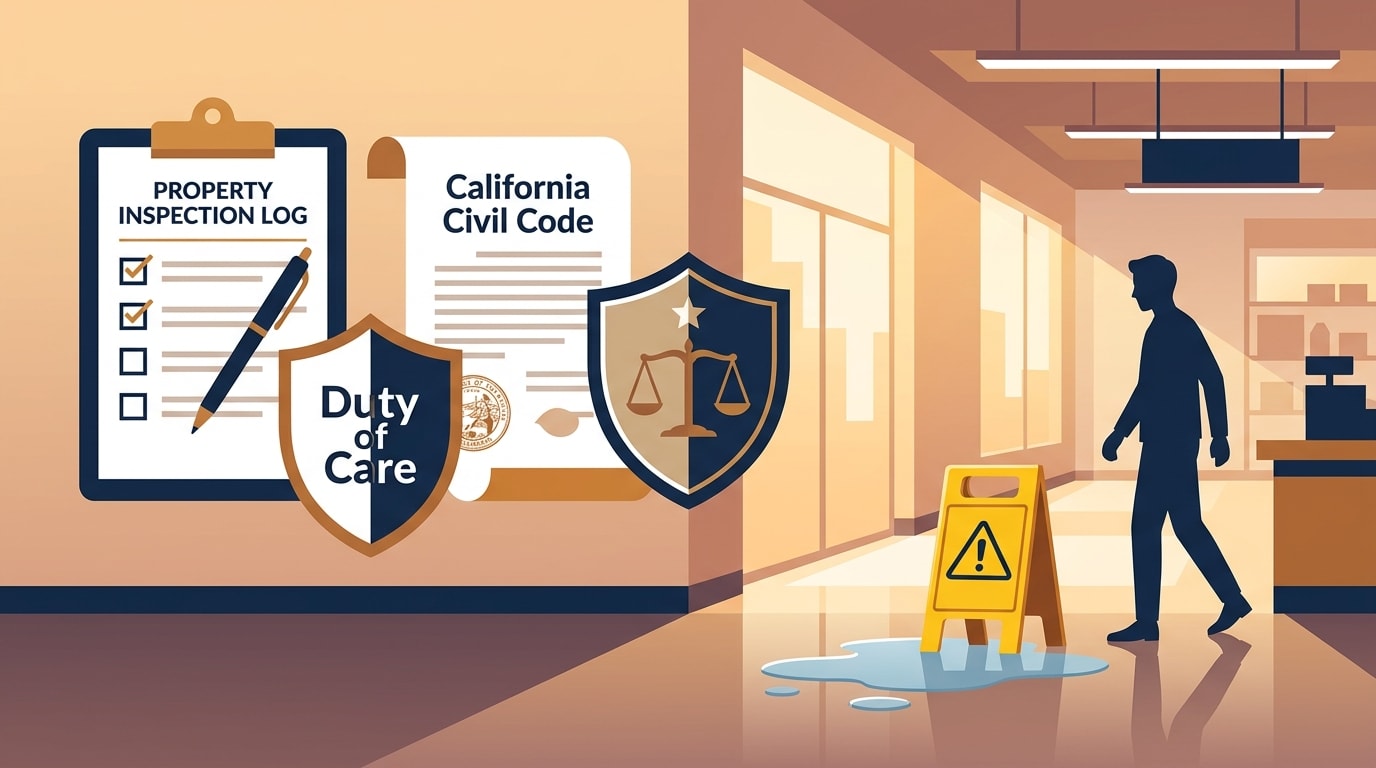
When you are injured on someone else's property — a wet floor in a grocery store, a broken staircase in an apartment building, a pothole in a parking lot — California law does not automatically make the property owner responsible. Instead, it requires you to prove that the owner or occupier failed to exercise reasonable care in maintaining the property, and that this failure caused your injury. The legal framework governing these claims is broader and more nuanced than many people realize. It applies not only to slip-and-fall accidents but to any injury caused by a dangerous condition on property — from inadequate security to falling merchandise to defective elevators. This guide explains how California premises liability works from the legal foundation up. It is general legal information, not legal advice.
California's duty of care for property owners
The legal foundation of every premises liability claim in California is Civil Code section 1714 (opens in new tab), which establishes that every person is responsible for injuries caused by their want of ordinary care or skill in the management of their property. This is not a special rule for property owners — it is the same general duty of care that applies to all negligence claims in California, applied specifically to the condition and management of real property.
What makes California's approach distinctive is the Rowland v. Christian decision, handed down by the California Supreme Court in 1968. Before Rowland, a property owner's duty of care depended on the visitor's legal status — whether they were an invitee (such as a business customer), a licensee (such as a social guest), or a trespasser. Each category carried a different level of protection, and the rigid classifications often produced outcomes that bore little relationship to what was actually reasonable.
Rowland swept away that framework. The Court held that a property owner owes a general duty of reasonable care to all persons who may be foreseeably injured by the condition of the property, regardless of the visitor's status. While the status of the visitor may still be considered as one factor in evaluating what is reasonable, it is no longer the controlling test. The question California courts ask is simpler and more direct: did the property owner act reasonably under the circumstances?
What you must prove in a premises liability claim
Premises liability is a form of negligence, and the plaintiff carries the burden of proving four elements:
Duty. The defendant owned, leased, occupied, or controlled the property where the injury occurred. In most cases this element is straightforward — the business operates the store, the landlord owns the building, the property management company maintains the grounds.
Breach. The defendant failed to exercise reasonable care in the inspection, maintenance, or management of the property. This can take many forms: failing to clean up a spill, neglecting to repair a known defect, providing inadequate lighting, or ignoring a hazard that routine inspection would have revealed.
Causation. The dangerous condition was a substantial factor in causing the plaintiff's injury. California uses the "substantial factor" test rather than the traditional "but for" test, which means the dangerous condition does not need to be the sole cause of the injury — it just needs to be more than a trivial or remote factor.
Damages. The plaintiff suffered actual, measurable harm — medical expenses, lost wages, pain and suffering, or other compensable losses.
The most common place premises liability cases fail is at the intersection of breach and causation: the plaintiff cannot show that the property owner knew about the hazard, or the defense successfully argues that the plaintiff's own conduct — not the property condition — caused the injury.
The "knew or should have known" standard
The most critical battleground in premises liability litigation is notice — proving that the property owner either knew about the dangerous condition or, through the exercise of reasonable care, should have known about it.
Actual notice is the clearest case. If a store employee saw a spill and walked past it, if a tenant reported a broken handrail and the landlord never repaired it, if a maintenance log documents a known defect — that is actual notice, and it is usually sufficient to establish breach.
Constructive notice is where most cases are fought. Constructive notice means the dangerous condition existed for a long enough period that a reasonably careful property owner, exercising ordinary inspection practices, would have discovered and addressed it. The question is not whether the owner actually knew, but whether they should have known.
Courts evaluate constructive notice by examining several factors:
- How long the hazard existed. A puddle that formed thirty seconds before the fall is different from one that sat on the floor for two hours. The longer the condition persisted, the stronger the argument that reasonable inspection would have caught it.
- The nature of the hazard. A large, visible spill in a high-traffic aisle presents a different notice question than a small, translucent liquid in a dimly lit corner.
- The property owner's inspection practices. Did the business have a regular sweep schedule? Were inspections documented? A store that inspects its floors every 30 minutes is in a stronger position than one with no documented inspection protocol.
- Whether the owner created the condition. If the property owner or its employees created the hazard — a mop left in a walkway, merchandise stacked unsafely — notice is presumed because the owner is the source of the danger.
This "time-on-floor" analysis is often the decisive factor in slip-and-fall cases. Without evidence establishing how long the hazard existed, a plaintiff may be unable to prove constructive notice.
Common defenses property owners use
Property owners and their insurance companies raise several recurring defenses in premises liability cases. Understanding these defenses helps evaluate the strength of a claim.
The "open and obvious" doctrine. This is one of the most frequently raised — and most frequently misunderstood — defenses. A property owner generally does not have a duty to warn visitors about hazards that are so obvious that a reasonable person would be expected to notice and avoid them. However, in California, the open and obvious doctrine is not an automatic bar to recovery. Even if a hazard is obvious, the property owner may still have a duty to remedy the condition if it is foreseeable that people will encounter it despite its obviousness — for example, when the hazard is located in a path that visitors must use and cannot reasonably avoid.
Comparative negligence. Under California's pure comparative negligence system, the property owner may argue that the plaintiff was partially responsible for their own injury — for example, by failing to watch where they were walking, wearing inappropriate footwear, or ignoring warning signs. Understanding how California's comparative negligence system reduces but does not eliminate recovery is important because even a plaintiff found significantly at fault can still recover a portion of their damages.
Lack of notice. As discussed above, the defense will argue that the property owner had no actual or constructive knowledge of the hazardous condition — that the spill happened moments before the fall, that the defect was not visible, or that inspection records show diligent maintenance.
Assumption of risk. In limited circumstances, the defense may argue that the plaintiff voluntarily encountered a known danger. This defense is more common in recreational settings than in commercial premises cases, but it can arise when a plaintiff was warned about a condition and chose to proceed anyway.
Commercial vs. residential liability
While the general duty of reasonable care applies to all property owners in California, the practical standard differs significantly depending on whether the property is commercial or residential.
Commercial properties — retail stores, restaurants, shopping centers, office buildings — are held to a proactive standard of care. Because these businesses invite the public onto their premises for commercial purposes, they are expected to actively seek out and address hazards before someone is injured. This includes conducting regular floor inspections on a documented schedule, maintaining adequate lighting in all areas accessible to customers, promptly addressing spills and obstructions, ensuring that shelving and merchandise displays are stable and secure, and providing reasonable security measures to protect visitors from foreseeable criminal acts.
The failure to maintain inspection protocols is itself evidence of negligence. A large retailer that has no documented sweep schedule cannot claim it exercised reasonable care simply because no employee happened to notice the spill.
Residential properties present a different landscape. Landlords owe a duty of care to their tenants and guests, but the specific obligations depend on the nature of the hazard and the degree of control the landlord retains over the property. Common areas — stairwells, walkways, parking lots, laundry rooms — are generally the landlord's responsibility. Conditions inside the rented unit may involve shared responsibility depending on the lease terms and the nature of the defect.
California's habitability laws add an additional layer. A landlord who fails to address a known hazard that affects the habitability of a rental unit — broken stairs, missing handrails, defective plumbing that creates slip hazards — may face liability under both premises liability and breach of the implied warranty of habitability.
When hazardous conditions at local businesses lead to injuries
The principles discussed throughout this guide apply with particular relevance to everyday situations in commercial retail environments — the places where most premises liability injuries actually occur. Wet floors near produce sections, uneven transitions between flooring surfaces, poorly lit parking lots, and merchandise that falls from shelving are among the most common hazard patterns.
For a detailed look at how slip-and-fall hazards manifest in local Victorville retail environments — including the specific challenges posed by high-traffic commercial corridors and the types of injuries these incidents produce — our local guide addresses the practical realities that residents encounter.
For a step-by-step explanation of the evidence and actions that strengthen a premises liability claim after a fall, our slip and fall injury guide walks through the process from the moment the incident occurs through the documentation that can make or break a case.
Understanding how premises liability claims are evaluated under California law matters because these cases depend heavily on the evidence gathered in the first hours and days after an injury — evidence that becomes much harder to obtain as time passes.
This resource is independent and free to use. It is not a law firm and does not provide legal advice. For advice about your specific situation, speak with a qualified attorney.