California Pedestrian Accident Claims Guide
A comprehensive guide to California pedestrian accident claims: right-of-way laws (CVC § 21950), the Freedom to Walk Act (AB 2147), insurance blame-shifting, and catastrophic injury compensation.
- By
- Victorville PI Resource Editorial Team
- Published
A pedestrian struck by a vehicle has no crumple zone, no airbag, no seatbelt. The human body absorbs the full force of the impact, and the injuries that result are often catastrophic — traumatic brain injuries, spinal fractures, crushed limbs, internal organ damage. But surviving the collision is only the beginning of the challenge. The legal process that follows is shaped by California-specific statutes governing right-of-way, recent changes to jaywalking enforcement, and an insurance industry that aggressively tries to shift blame onto the person who was walking. This guide explains how California pedestrian accident law works, what rights pedestrians actually have, and how claims are pursued and defended. It is general legal information, not legal advice.
Why pedestrian accident claims are different
The physics of a pedestrian collision create a category of case that is fundamentally different from vehicle-versus-vehicle crashes. A passenger car weighs roughly 4,000 pounds. A pedestrian weighs roughly 150 to 200 pounds. When these two collide, even at relatively low speeds, the energy transfer is devastating and entirely one-directional. The pedestrian absorbs virtually all of the impact force.
This disparity produces injuries that are disproportionately severe. While a fender-bender between two cars might result in soft-tissue strain, the same speed collision with a pedestrian can cause compound fractures, internal bleeding, traumatic brain injury, or death. The medical costs associated with pedestrian injuries are typically far higher than comparable motor vehicle crash injuries, and the recovery timelines are longer — often measured in years rather than months.
The legal landscape is also different. Pedestrian cases involve specific Vehicle Code provisions that do not apply to car-versus-car collisions. They involve questions about crosswalk status, right-of-way, and pedestrian conduct that have no analog in standard traffic accident claims. And they involve an insurance defense playbook that is specifically designed to blame the injured pedestrian — often by exploiting public misunderstanding of jaywalking laws and pedestrian rights.
California's pedestrian right-of-way laws
The foundation of California pedestrian law is Vehicle Code section 21950 (opens in new tab), which establishes the rights and responsibilities of both drivers and pedestrians at crosswalks.
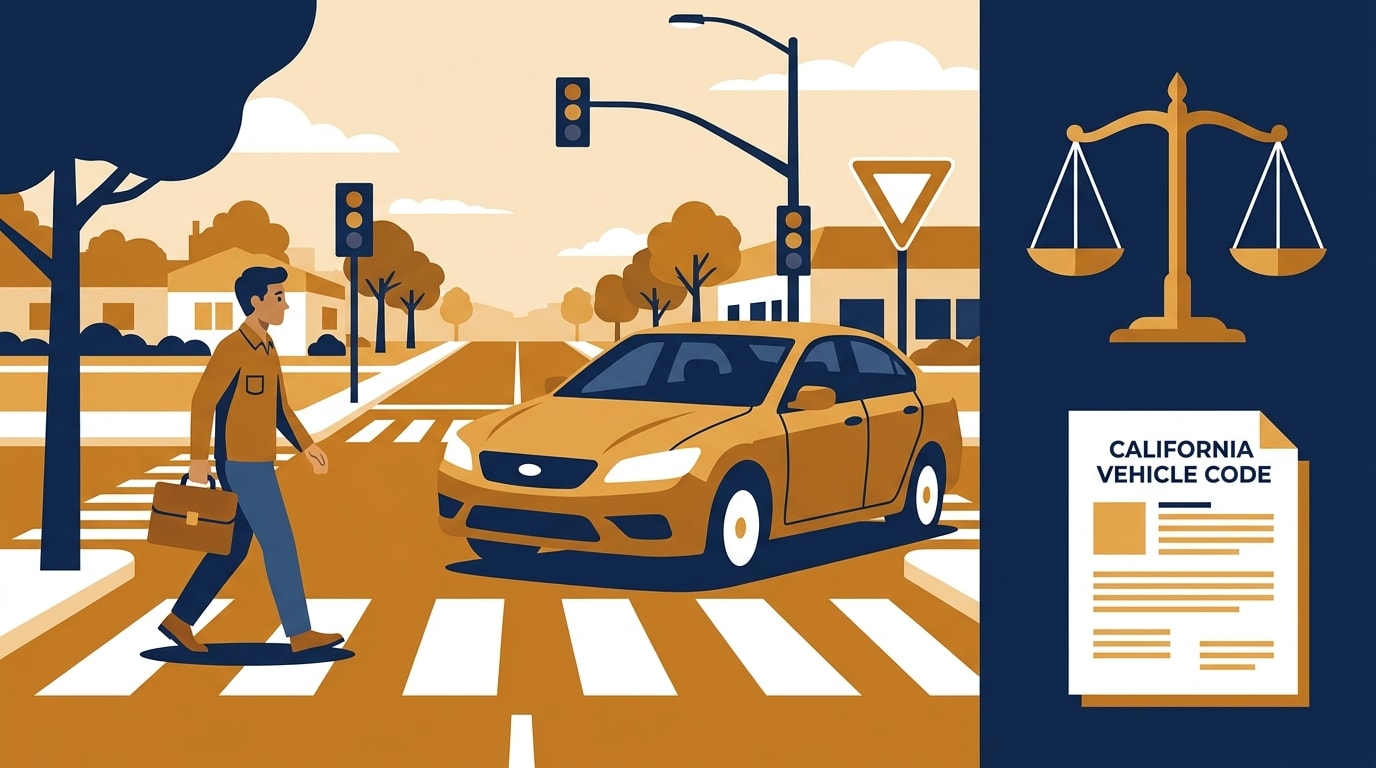
The driver's duty is clear and affirmative. CVC § 21950(a) requires drivers to yield the right-of-way to any pedestrian crossing the roadway within any marked or unmarked crosswalk at an intersection. The statute goes further: drivers must exercise "all due care" for the safety of the pedestrian, which includes reducing speed or taking any other action necessary to safeguard the pedestrian. This is not a passive obligation — it requires the driver to actively watch for and protect pedestrians.
Unmarked crosswalks are a critical concept that many people — including some insurance adjusters — do not fully understand. California law recognizes that a crosswalk exists at every intersection, whether or not it is painted on the road. An unmarked crosswalk is the natural extension of the sidewalk or shoulder across the intersection. Pedestrians crossing within this zone have the same legal protections as those using a painted crosswalk.
The pedestrian's duty is reciprocal but more limited. CVC § 21950(b) provides that a pedestrian may not suddenly leave a curb or other place of safety and walk or run into the path of a vehicle that is so close as to constitute an immediate hazard. This is not a blanket prohibition against entering a crosswalk when vehicles are present — it prohibits only the sudden, unexpected entry into the path of a vehicle that is already too close to stop safely.
The Freedom to Walk Act and what it changed
On January 1, 2023, California's Freedom to Walk Act (Assembly Bill 2147) fundamentally changed how jaywalking is enforced in the state. The law directly affects how pedestrian accident claims are investigated and argued.
Before AB 2147, a pedestrian crossing outside of a crosswalk could be cited for jaywalking regardless of whether their crossing was actually dangerous. Police officers routinely issued jaywalking citations, and insurance adjusters used those citations — or even the mere allegation of jaywalking — as evidence that the pedestrian was at fault for the collision.
The Freedom to Walk Act changed the enforcement standard. Under the new law, a police officer cannot stop or cite a pedestrian for crossing outside of a crosswalk unless a "reasonably careful person" would realize there is an immediate danger of a collision with a moving vehicle or other device.
What the law does not do is equally important. AB 2147 does not make all mid-block crossings legal. It does not eliminate a pedestrian's duty to exercise reasonable care for their own safety. And it does not prevent an insurance company from arguing that a pedestrian's crossing location contributed to the accident. What it does is remove the automatic assumption that crossing outside a crosswalk is inherently negligent — and it eliminates the pretextual jaywalking citations that insurance companies previously relied on to establish pedestrian fault.
The practical effect on claims is significant. Before the Freedom to Walk Act, an adjuster could point to a jaywalking citation and argue that the pedestrian was presumptively at fault. Now, the question is whether the pedestrian's crossing was actually dangerous under the circumstances — a much harder argument for the insurance company to make if the driver was speeding, distracted, or failed to keep a proper lookout.
How insurance companies blame pedestrians
Insurance adjusters handling pedestrian accident claims use a specific playbook designed to shift as much fault as possible onto the injured pedestrian. Because California's pure comparative negligence system reduces the payout by the pedestrian's percentage of fault, even a small shift in blame can save the insurance company significant money on a catastrophic injury claim.
"They were jaywalking." This is the most common defense, and it is often raised even when the pedestrian was crossing in a legal crosswalk. The adjuster may argue that the pedestrian was outside the crosswalk lines, that they crossed against a signal, or that they were in a location where "no reasonable pedestrian" would cross. The Freedom to Walk Act has weakened this argument, but adjusters continue to use it.
"They were distracted." The adjuster may allege that the pedestrian was looking at a phone, wearing headphones, or otherwise not paying attention to traffic. Even without direct evidence, the suggestion of distraction can influence how fault is allocated.
"They were wearing dark clothing." In nighttime or low-light collisions, adjusters frequently argue that the pedestrian was difficult to see because of their clothing color. This shifts the focus from the driver's obligation to maintain a proper lookout and use headlights appropriately onto the pedestrian's wardrobe choices.
"They stepped out suddenly." This defense invokes CVC § 21950(b) — the prohibition against suddenly entering the path of a vehicle that constitutes an immediate hazard. But the defense often stretches this provision far beyond its intended scope, applying it to situations where the pedestrian was visible for several seconds before the collision.
Understanding how California's pure comparative negligence system allocates fault between drivers and pedestrians is essential because these blame-shifting tactics do not need to eliminate the pedestrian's claim entirely — they only need to increase the pedestrian's fault percentage enough to meaningfully reduce the insurance company's payout.
Catastrophic pedestrian injuries and long-term costs
Pedestrian accident injuries are among the most severe and most expensive injury categories in personal injury law. The combination of no protective barrier, direct impact, and secondary injuries from falling onto pavement or being thrown by the collision creates a pattern of injuries that frequently requires years of medical treatment.
Traumatic brain injuries occur even in collisions at moderate speeds. The initial impact can cause the pedestrian's head to strike the vehicle's hood or windshield, and the secondary impact — when the pedestrian hits the ground — can cause additional brain trauma. Concussions, contusions, and diffuse axonal injuries are common, and their effects may not be fully apparent for days or weeks after the collision.
Spinal cord injuries can result in partial or complete paralysis. A pedestrian struck from behind or at an angle may suffer compression fractures, herniated discs, or direct cord damage. The lifetime cost of care for a spinal cord injury — including medical treatment, adaptive equipment, home modifications, and attendant care — can reach millions of dollars.
Orthopedic injuries in pedestrian crashes tend to follow a characteristic pattern. The initial point of impact is often the lower extremities — tibial plateau fractures, femur fractures, and knee ligament destruction are common "bumper injuries" caused by the vehicle's front end striking the pedestrian at leg height. These injuries frequently require multiple surgeries and may result in permanent mobility limitations.
Internal organ damage — ruptured spleens, liver lacerations, kidney injuries — can be life-threatening and may require emergency surgery. These injuries are not always immediately apparent, which is why prompt and thorough medical evaluation after a pedestrian collision is critical.
Understanding the deadlines for filing a personal injury claim is particularly important in pedestrian cases because some injuries — especially traumatic brain injuries and internal damage — may not be fully diagnosed until weeks or months after the collision, and the statute of limitations clock begins running from the date of the accident.
When pedestrian crashes happen in commercial retail areas
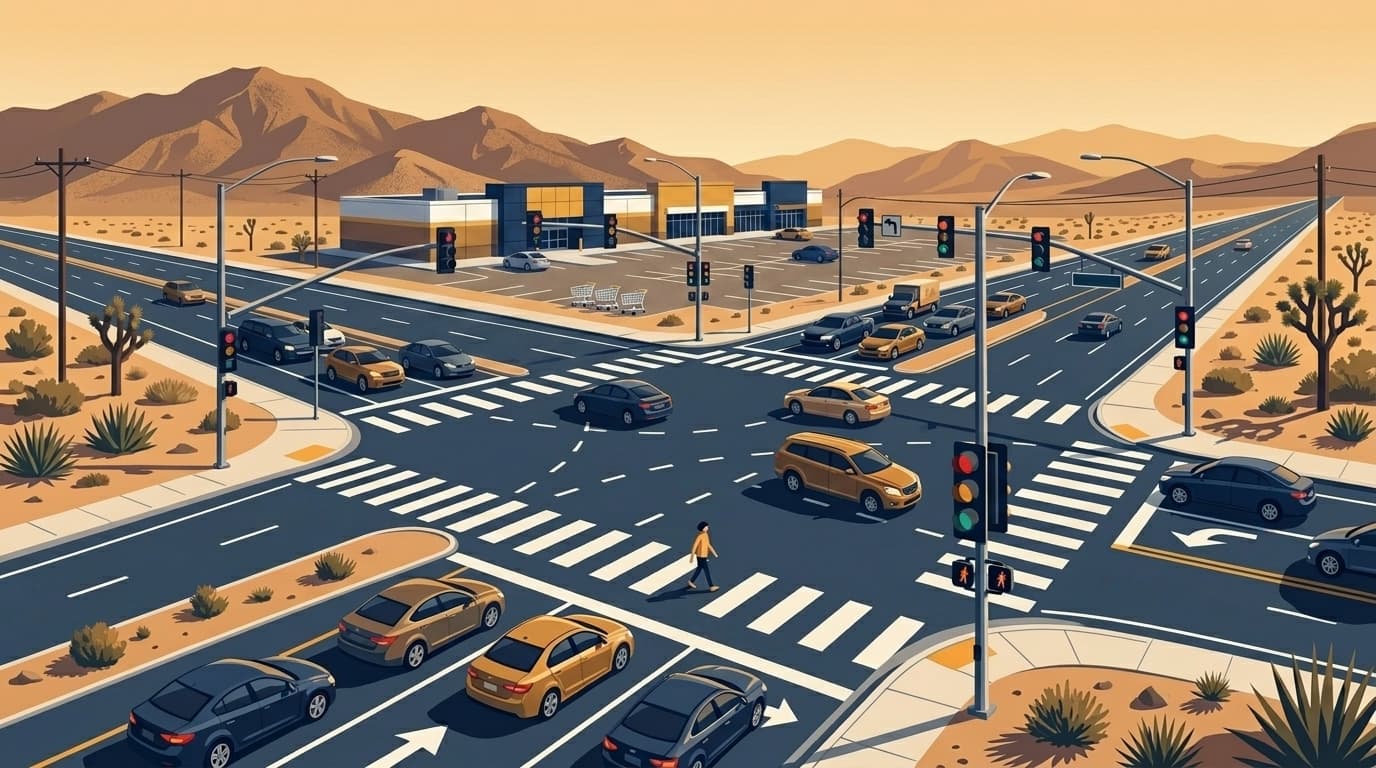
While pedestrian collisions can occur anywhere, a disproportionate number happen in commercial retail environments — shopping center parking lots, big-box store driveways, strip mall access roads, and the wide arterial intersections that connect them. These locations concentrate pedestrian traffic in areas designed primarily for vehicle throughput, creating inherent conflict points.
The design of many commercial corridors — wide lanes, high speed limits, multiple driveway cuts, limited pedestrian infrastructure — prioritizes vehicle flow over pedestrian safety. When a pedestrian must cross four or five lanes of traffic to reach a bus stop, a store entrance, or a parking area, the risk of collision increases substantially.
For a detailed look at how these hazards manifest in local High Desert retail corridors — including the specific intersection designs, commercial driveway configurations, and pedestrian infrastructure gaps that contribute to crashes in the Victorville area — our local guide addresses the practical realities that residents and visitors encounter daily.
Understanding how pedestrian accident claims are evaluated under California law matters because these cases often involve questions about road design, crosswalk availability, and whether the property owner or municipality bears responsibility for creating conditions that put pedestrians at risk.
This resource is independent and free to use. It is not a law firm and does not provide legal advice. For advice about your specific situation, speak with a qualified attorney.