Concussion Car Accident Claim in California
California concussion and mild TBI claim guide: why a normal CT scan does not rule out brain injury, post-concussion syndrome, DTI imaging, neuropsych testing, and proving invisible disability.
- By
- Victorville PI Resource Editorial Team
- Published
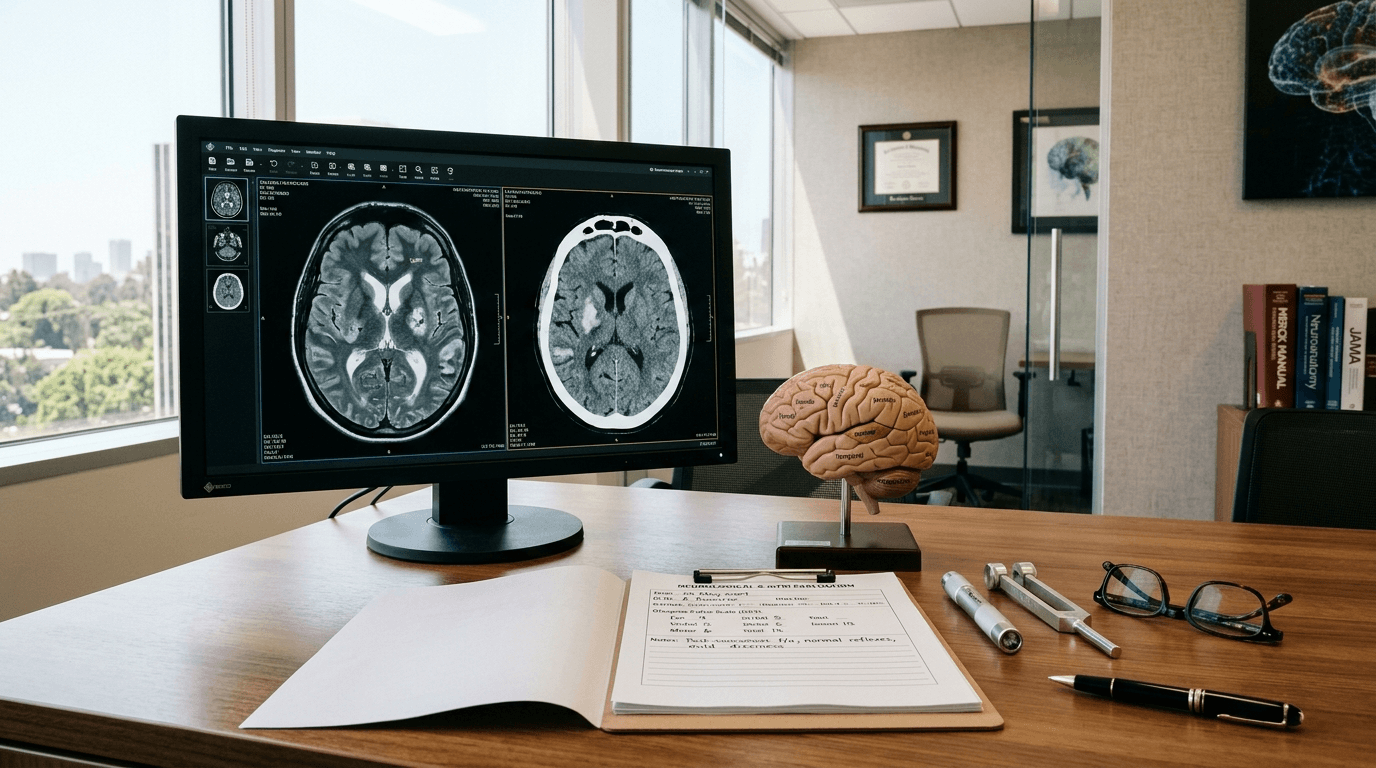
The emergency room doctor told you the CT scan was "normal" and sent you home. But three weeks later, you cannot remember conversations. You lose your train of thought mid-sentence. Bright lights feel like needles behind your eyes. Your family says your personality has changed — you are irritable, short-tempered, and emotionally volatile in ways you never were before the crash. You are not imagining this. A normal CT scan does not mean your brain is fine. It means the ER checked for the injuries that kill you in hours and found none. The injuries that disable you for months or years require entirely different diagnostic tools — tools the emergency room did not use.
Why your "normal" CT scan does not mean you are fine
Emergency rooms at Desert Valley Hospital, Victor Valley Global Medical Center, and nearly every ER in California follow acute triage protocols. When a crash victim presents with head impact or loss of consciousness, the ER orders a non-contrast CT scan of the head. This scan has one purpose: detect conditions that require emergency neurosurgical intervention within hours — subdural hematomas (bleeding between the brain and the skull), epidural hematomas (arterial bleeding that compresses the brain), and skull fractures that risk brain penetration.
A CT scan accomplishes this critical screening with high reliability. What it cannot do — and was never designed to do — is detect the cellular-level brain damage that causes post-concussion symptoms.
When your brain is violently accelerated and decelerated inside the skull during a crash, the axons (the long nerve fibers that connect brain cells and carry signals between brain regions) can stretch, shear, and tear. This is called diffuse axonal injury (DAI). The damage occurs at a microscopic scale — individual nerve fibers disrupted across thousands of connection points throughout the brain. No CT scan and no standard MRI can visualize this damage.
Simultaneously, the collision triggers a neurometabolic cascade — a flood of calcium, potassium, and inflammatory chemicals that disrupts normal brain cell function for weeks or months. The brain looks structurally normal on imaging while functioning abnormally at the cellular level. This is why the ER doctor cleared you. Your brain was not bleeding. But your brain was — and may still be — injured.
Post-Concussion Syndrome: the invisible disability adjusters refuse to acknowledge
Post-Concussion Syndrome (PCS) describes the cluster of symptoms that persist weeks, months, or years after the initial concussion. The Centers for Disease Control and Prevention (opens in new tab) recognizes PCS as a legitimate medical condition with documented cognitive, physical, and emotional components.
Cognitive symptoms include short-term memory loss, difficulty concentrating, mental fog, slowed processing speed, and word-finding problems. Victims describe feeling like they are "thinking through mud." Tasks that were automatic before the crash — remembering appointments, following multi-step instructions at work, managing household finances — become exhausting or impossible.
Physical symptoms include chronic headaches (often daily), light sensitivity (photophobia), noise sensitivity (phonophobia), dizziness, balance problems, and disrupted sleep patterns. Many PCS patients cannot tolerate fluorescent lighting, computer screens, or crowded environments.
Emotional and behavioral symptoms include irritability, anxiety, depression, emotional volatility (crying or rage triggered by minor stimuli), and personality changes that family members notice before the victim does.
Insurance adjusters categorize all of this as "just headaches" — a phrase designed to trivialize the entire symptom complex into a minor, temporary complaint worth a few thousand dollars. The adjuster knows that if PCS is properly documented and classified as a mild traumatic brain injury (mTBI), the claim value escalates toward policy limits.
The diagnostic tools that prove your brain injury is real
The diagnostic tools that detect concussion-level brain damage are not available in emergency rooms. They require referral to a neurologist or neuropsychologist, and most crash victims are never told they exist.
Diffusion Tensor Imaging (DTI) is an advanced MRI technique that maps the integrity of white matter tracts — the axonal highways that connect brain regions. DTI can detect disruptions in these tracts that are invisible on standard MRI sequences. A DTI scan that shows reduced fractional anisotropy (FA values) in specific white matter regions provides objective, visualizable evidence that axonal connections have been damaged. This finding transforms a subjective symptom complaint into a documented structural brain injury.
Quantitative neurocognitive testing (ImPACT testing) measures processing speed, reaction time, verbal memory, visual memory, and impulse control against normative baselines. The ImPACT test produces numerical scores that objectively document cognitive deficits. When a 35-year-old professional scores in the 15th percentile on processing speed — a metric where they would have scored in the 70th percentile before the crash — the deficit is quantified and undeniable.
Comprehensive neuropsychological evaluation is a multi-hour battery of standardized cognitive tests administered by a licensed neuropsychologist. This evaluation produces a detailed report documenting specific cognitive domains that are impaired (attention, executive function, working memory, verbal fluency) and the severity of impairment relative to the patient's estimated pre-injury functioning.
None of these tests are ordered by emergency rooms. None are part of standard post-crash follow-up care. If you do not know to ask for them — or if your attorney does not know to refer you — the invisible brain damage remains invisible, and the adjuster's "just headaches" narrative prevails.
How a Victorville brain injury attorney proves invisible cognitive disability
Proving a mild TBI in a California personal injury claim requires a strategic combination of expert testimony and lay witness evidence that together make the invisible visible.
Expert neuropsychologist testimony presents the DTI findings, neurocognitive test scores, and clinical evaluation in a format that adjusters and juries can understand. The neuropsychologist explains which brain regions are damaged, how those regions control specific cognitive functions, and why the documented deficits are consistent with traumatic brain injury rather than malingering or pre-existing conditions.
"Before-and-after" lay witness statements are often the most emotionally powerful evidence in a TBI claim. Family members, close friends, coworkers, and supervisors describe the person they knew before the crash and the person they see now. A spouse describes a partner who can no longer manage the family calendar, who forgets conversations they had that morning, who becomes enraged over minor frustrations. A supervisor describes an employee whose work quality deteriorated, who misses deadlines they never missed before, who can no longer handle multitasking that was routine before the crash.
Employment and academic records provide objective documentation of functional decline. Performance reviews that were consistently positive before the crash and then decline afterward create a timeline that correlates with the injury. For younger victims, grade records, standardized test scores, and teacher observations document cognitive regression.
The combination of objective diagnostic evidence (DTI, neuropsych testing) and subjective human testimony (family, coworkers) creates a claim narrative that the adjuster's "just headaches" defense cannot overcome.
What concussion and mild TBI claims are worth in California
The term "mild TBI" is one of the most misleading phrases in medicine. "Mild" refers to the initial presentation — brief loss of consciousness or alteration of consciousness — not to the outcome. Patients with "mild" TBI can suffer debilitating cognitive disability that permanently impairs their ability to work, maintain relationships, and live independently.
When a mild TBI is properly documented with DTI imaging, neuropsychological evaluation, and consistent neurological treatment, the claim value escalates rapidly toward policy limits. A documented mTBI with persistent PCS in a working professional — someone who can demonstrate lost earning capacity through before-and-after employment records — routinely generates demand packages in the $250,000 to $500,000 range and above.
A Victorville brain injury lawyer who specializes in TBI cases understands the diagnostic pathway, maintains relationships with qualified neuropsychologists, and knows how to present invisible cognitive disability in a format that forces the insurance company to evaluate the claim at its true value. Understanding TBI settlement ranges in California and the broader California TBI claims process helps you recognize when an adjuster's offer reflects their exposure — and when it reflects their hope that you will not fight.
This resource is independent and free to use. It is not a law firm and does not provide legal advice. For advice about your specific situation, speak with a qualified attorney.